A Practical and Safe Demonstration of Brine Electrolysis Using a Button Cell
Contributors


Summary
Practical demonstrations can help students develop scientific abilities and practice inquiry more effectively than lectures and theory alone. To explore redox reactions and changes in pH, a salt mixture, such as brine or seawater, can be converted into chlorine, hydrogen, and sodium hydroxide through electrolysis. This connects topics across chemistry, including categorizing substances and mixtures, to acids and bases, and electrochemistry, as well as the industrial production of chlorine and caustic soda through the Chloralkali process. However, potential exposure to electrical hazards, toxic chlorine, and flammable hydrogen gas presents risks to students and demonstrators.
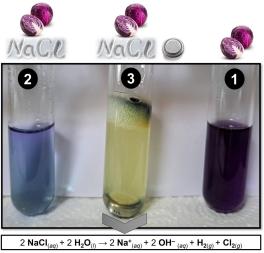
Towards a safe, accessible, and simple electrolysis demonstration, a low-cost milliliter-scale setup is suitable for use in the lecture classroom or laboratory using salt water, a button cell battery, a test tube, and an indicator solution made from red cabbage. During the experiment, gas bubbles form around the button cell and travel through the indicator solution. The anthocyanins in the cabbage solution act as a pH indicator, changing colour: red (acidic), purple (neutral), blue and green (mildly basic), then yellow (strongly basic). This corresponds to changes in the anthocyanin ring structures, allowing for a discussion of conjugation. Pupils and students can easily and safely observe the pH of the solution, identifying visual cues with changes in reactants and products. The demonstration also provides an opportunity to introduce and relate the 12th principle of green chemistry, Safer Chemistry for Accident Prevention, and the 12th United Nations Sustainable Development Goal, Responsible Production and Consumption. The quick, vivid colour transitions, combined with appropriate safety measures (safety goggles, small scale), make this an easy-to-understand introduction to mixtures, pH, electrolysis, and good laboratory practices.
Towards a safe, accessible, and simple electrolysis demonstration, a low-cost milliliter-scale setup is suitable for use in the lecture classroom or laboratory using salt water, a button cell battery, a test tube, and an indicator solution made from red cabbage. During the experiment, gas bubbles form around the button cell and travel through the indicator solution. The anthocyanins in the cabbage solution act as a pH indicator, changing colour: red (acidic), purple (neutral), blue and green (mildly basic), then yellow (strongly basic). This corresponds to changes in the anthocyanin ring structures, allowing for a discussion of conjugation. Pupils and students can easily and safely observe the pH of the solution, identifying visual cues with changes in reactants and products. The demonstration also provides an opportunity to introduce and relate the 12th principle of green chemistry, Safer Chemistry for Accident Prevention, and the 12th United Nations Sustainable Development Goal, Responsible Production and Consumption. The quick, vivid colour transitions, combined with appropriate safety measures (safety goggles, small scale), make this an easy-to-understand introduction to mixtures, pH, electrolysis, and good laboratory practices.
Keyword Tags
File (PDF, PPT, image, etc)
Digital Object Identifier (DOI)
https://doi.org/10.59877/UNTB5186
Creative Commons License

This work is licensed under a Creative Commons Attribution-NonCommercial-ShareAlike 4.0 International License.
Comments
Have you tried this with other pH indicators that can be directly purchased?
In reply to Have you tried this with… by Joe Christopher
Of course. They create beautiful color transitions.
Hi Marko and Julian, I love your rendition of electrolysis—elegant and sustainable. I particularly love the use of cabbage as the indicator. I would like to ask, how do you usually deal with the used-up button batteries?
In reply to Hi Marko and Julian, I love… by Jerald Villarmino
Hi Jerald, thank you for pointing that out. Yes, we mention in the article/resource that batteries should be dried, wrapped in tape, and disposed of according to local waste management regulations. Different regions may have specific requirements, so it is best to follow the guidance provided by your local waste disposal authority.