A Practical and Safe Demonstration of Brine Electrolysis Using a Button Cell

A Practical and Safe Demonstration of Brine Electrolysis Using a Button Cell
Contributors
Researcher | Jožef Stefan Institute
Assistant Professor | Fashion Institute of Technology
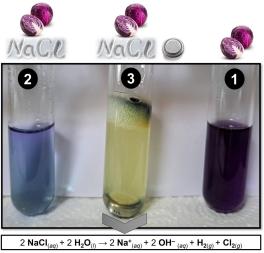
Experimental demonstration. Test tube (3) after reaction, where the natural indicator changed the colour, comparable with test tube (1) (solution of indicator red cabbage) and test tube (2) (solution of indicator red cabbage, with addition of salt water). Electrolysis of an aqueous NaCl solution gives a mixture of hydrogen (H2) and chlorine (Cl2) gases and an aqueous sodium hydroxide solution (NaOH).
Summary
Practical demonstrations can help students develop scientific abilities and practice inquiry more effectively than lectures and theory alone. To explore redox reactions and changes in pH, a salt mixture, such as brine or seawater, can be converted into chlorine, hydrogen, and sodium hydroxide through electrolysis. This connects topics across chemistry, including categorizing substances and mixtures, to acids and bases, and electrochemistry, as well as the industrial production of chlorine and caustic soda through the Chloralkali process. However, potential exposure to electrical hazards, toxic chlorine, and flammable hydrogen gas presents risks to students and demonstrators.

Towards a safe, accessible, and simple electrolysis demonstration, a low-cost milliliter-scale setup is suitable for use in the lecture classroom or laboratory using salt water, a button cell battery, a test tube, and an indicator solution made from red cabbage. During the experiment, gas bubbles form around the button cell and travel through the indicator solution. The anthocyanins in the cabbage solution act as a pH indicator, changing colour: red (acidic), purple (neutral), blue and green (mildly basic), then yellow (strongly basic). This corresponds to changes in the anthocyanin ring structures, allowing for a discussion of conjugation. Pupils and students can easily and safely observe the pH of the solution, identifying visual cues with changes in reactants and products. The demonstration also provides an opportunity to introduce and relate the 12th principle of green chemistry, Safer Chemistry for Accident Prevention, and the 12th United Nations Sustainable Development Goal, Responsible Production and Consumption. The quick, vivid colour transitions, combined with appropriate safety measures (safety goggles, small scale), make this an easy-to-understand introduction to mixtures, pH, electrolysis, and good laboratory practices.
Digital Object Identifier (DOI)
https://doi.org/10.59877/UNTB5186
Learning Goals/Student Objectives
After the activities, the primary school pupils will be able to:
1. describe what electrolysis is and why it is used;
2. recognise that salt water can be used to produce new gases using electricity;
3. safely perform a chemistry experiment using a button battery;
4. observe changes and describe what happens during the experiment;
5. consider how science is used in everyday life, such as in water purification or gas production.

After demonstrating or performing the experiment, high school students will be able to:
1. explain the basic principle of electrolysis and describe the electrolysis of brine;
2. write the chemical reactions at the anode and cathode (verbally at a basic level and as chemical equations at a higher level);
3. understand how electrolysis can be safely performed using a small voltage source, such as a button cell battery;
4. describe the properties and uses of the resulting products (Cl₂, H₂, NaOH);
5. demonstrate an understanding of the safe handling of chemicals and electrical sources.

Students of pedagogical sciences (natural sciences/ chemistry/ education) will, through experimental activities:
1. deepen their understanding of the principles of electrolysis, with a focus on the electrolysis of NaCl(aq);
2. analyse reactions at the electrodes and interpret gas production and pH changes in the electrolyte;
3. evaluate the didactic advantages of using a button battery as a safe energy source for school demonstrations;
4. plan how to present the experiment to students of different ages (vertical planning);
5. critically consider the possibilities of including micro-experiments in modern chemistry lessons from the perspectives of safety, sustainability, and accessibility.
Object Type
Laboratory experiment
Journal articles
Audience
Elementary School
Middle School
High School (Secondary School)
Introductory Undergraduate
Upper/Advanced Undergraduate
Other Faculty Educators/Teachers
Environmental Health & Safety (EH&S)
Common pedagogies covered
Blended learning
Collaborative/cooperative learning
Context-based learning
Hands-on learning
Problem-based learning
Green Chemistry Principles
Less Hazardous Chemical Syntheses
Designing Safer Chemicals
U.N. Sustainable Development Goals (SDGs)
Quality Education
Safety Precautions, Hazards, and Risk Assessment
Safety first! Never ingest small button cell batteries, as they can cause severe internal chemical burns. To dispose of them properly, wrap both sides of the battery in clear tape to prevent fires and drop them off at a designated battery recycling center rather than the trash.

More information:
(1) Johns Hopkins Medicine; Dangers of button batteries and kids:
https://www.hopkinsmedicine.org/health/wellness-and-prevention/dangers-of-button-batteries-and-kids
(2) NHS; Button batteries – using them safely:
https://www.gosh.nhs.uk/conditions-and-treatments/conditions-we-treat/button-batteries-using-them-safely/

It is recommended that this experiment should not be performed at home and should only be conducted under the supervision of a qualified adult, such as a teacher, instructor, or experienced demonstrator. Primary school students should only observe the experiment, which should be performed by a teacher or demonstrator with appropriate explanation.

This demonstration involves the electrolysis of a dilute sodium chloride (brine) solution using a low-voltage button cell (e.g. 1.5 V), which ensures a safe and controlled environment. The primary products of the reaction are hydrogen gas, chlorine gas (in small quantities), and sodium hydroxide in solution.

Safety precautions
1. Ventilation: Conduct the demonstration in a well-ventilated area or under a fume hood, especially if using more than a few mL of brine.
2. Scale and duration: Keep the scale small (e.g., a few mL of solution) and limit the electrolysis time to a few minutes to minimize chlorine production.
3. Personal Protective Equipment (PPE): lab coat, (nitrile) gloves, safety goggles.
4. Waste disposal: Neutralize the remaining solution with vinegar before disposal. Dispose of the solution down the drain with plenty of water (if allowed by local regulations).
5. Battery handling: Ensure the button cell is not leaking or damaged. Do not short-circuit the battery terminals.

Hazards
Hydrogen gas (H₂): Flammable and explosive in high concentrations,
Chlorine gas (Cl₂): Toxic and irritating to eyes, skin, and respiratory system.
Sodium hydroxide (NaOH): Corrosive at higher concentrations; may cause skin/eye irritation.
Electrical hazard: Very low risk due to low voltage (1.5 V), but good practice still applies.
Glassware or container breakage: Minor injury hazard due to sharp fragments.

Risk Assessment
1. Hazard: Hydrogen gas ignition
Likelihood: Low
Severity: Moderate
Risk Level: Low
Mitigation measures: Small scale, avoid open flames or sparks

2. Hazard: Chlorine gas exposure
Likelihood: Low
Severity: Moderate
Risk Level: Low
Mitigation measures: Good ventilation, short duration

3. Hazard: NaOH skin/eye contact
Likelihood: Low
Severity: Low–Moderate
Risk Level: Low
Mitigation measures: Wear gloves and goggles

4. Hazard: Electrical shock
Likelihood: Very Low
Severity: Very Low
Risk Level: Negligible
Mitigation measures: Low voltage used

5. Hazard: Breakage of container
Likelihood: Low
Severity: Low
Risk Level: Low
Mitigation measures: Use plastic or borosilicate glass containers
Teacher Recommendations or Piloting Data (if available)
The experiment may be conducted independently by university and secondary school students under the supervision of a teacher or demonstrator. Primary school students should only observe the experiment, which should be performed by a teacher or demonstrator with appropriate explanation.

During the Demonstration:
Encourage students to make predictions: What gases will form? Which electrode will produce more bubbles?
Discuss the identification of gases using splint tests (optional for advanced classes).
Limit the experiment to 5–10 minutes to prevent noticeable chlorine build-up.

Discussion Questions:
What evidence do we have that a chemical reaction occurred?
What roles do the anode and cathode play?
Why is using a button cell safer than a traditional power supply?

Extension:
Use different salts (e.g., KCl, Na₂SO₄) to compare gas production.
Link to industrial applications (chlor-alkali process).
Explore redox half-equations in more advanced classes.
NGSS Standards, if applicable
Electrolysis NaCl:
• HS-PS1-2: Construct and revise an explanation for the outcome of a simple chemical reaction based on the outermost electron states of atoms, trends in the periodic table, and knowledge of the patterns of chemical properties.
• HS-PS1-5: Apply scientific principles and evidence to provide an explanation about the effects of changing the temperature or concentration of the reacting particles on the rate at which a reaction occurs.
• HS-PS3-3: Design, build, and refine a device that works within given constraints to convert one form of energy into another form of energy.

Using red cabbage:
• MS-PS1-2: Analyze and interpret data on the properties of substances before and after the substances interact to determine if a chemical reaction has occurred.
• HS-PS1-3: Plan and conduct an investigation to gather evidence to compare the structure of substances at the bulk scale to infer the strength of electrical forces between particles.
• HS-PS1-2: Construct and revise an explanation for the outcome of a simple chemical reaction.

Share This

Submitted by

Reviewed by
Published on
Moderation state
Published
Time required (if applicable)
30 minutes
Other notes/information
When performed on a small scale with proper safety precautions, the electrolysis of brine using a button cell is a safe and educational experiment suitable even for classroom demonstrations. The low voltage, minimal gas production, and ease of control make this a low-risk procedure. Nevertheless, basic lab safety protocols must be followed to ensure the safety of all participants.

Comments

Have you tried this with other pH indicators that can be directly purchased?

Hi Marko and Julian, I love your rendition of electrolysis—elegant and sustainable. I particularly love the use of cabbage as the indicator. I would like to ask, how do you usually deal with the used-up button batteries?

Hi Jerald, thank you for pointing that out. Yes, we mention in the article/resource that batteries should be dried, wrapped in tape, and disposed of according to local waste management regulations. Different regions may have specific requirements, so it is best to follow the guidance provided by your local waste disposal authority.

Creative Commons License