RECOMPENSE: A Student-Led Open Science Initiative for Sustainable Polystyrene Waste Upcycling in Academic Labs
Contributors

Summary
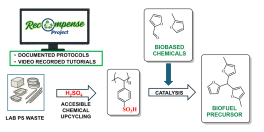
Plastic waste is a global challenge, with polystyrene (PS) among the least recycled polymers despite its widespread use in laboratories. Conventional recycling routes for PS remain economically and technically limited, creating an urgent need for accessible, sustainable alternatives. Here, we introduce RECOMPENSE, a student-led open science initiative designed to upcycle PS waste into polystyrene sulfonic acid (u-PSSA), a heterogeneous catalyst for green organic synthesis. Developed through MSc research projects at UCL, RECOMPENSE combines technical innovation with educational engagement, offering detailed protocols and video resources freely available online. We report a reproducible method for sulfonating expanded PS under simple laboratory conditions, yielding u-PSSA with up to 45% sulfonation. Its catalytic performance was validated in Friedel–Crafts reactions using biobased substrates, achieving quantitative yields of a biofuel precursor under mild conditions. Comparative studies with commercial PSSA confirmed the viability of waste-derived catalysts, while additional tests with aromatic aldehydes demonstrated broad applicability. Beyond experimental results, RECOMPENSE exemplifies co-creation in sustainable chemistry education. By involving students in research and resource development, the project fosters practical skills, systems thinking, and global collaboration. demonstrating how academic labs can transform plastic waste into valuable resources while preparing future scientists to lead sustainability transitions.
Full citation: Lageard, V., Yan, Y., Liu, J., Gong, Y., Liu, S., Schroeder, B. C., & Palomas, D. (2026). RECOMPENSE: A Student-Led Open Science Initiative for Sustainable Polystyrene Waste Upcycling in Academic Labs. RSC Sustainability, 1986-1995 https://doi.org/10.1039/D5SU00927H
Full citation: Lageard, V., Yan, Y., Liu, J., Gong, Y., Liu, S., Schroeder, B. C., & Palomas, D. (2026). RECOMPENSE: A Student-Led Open Science Initiative for Sustainable Polystyrene Waste Upcycling in Academic Labs. RSC Sustainability, 1986-1995 https://doi.org/10.1039/D5SU00927H