Event
Event Description
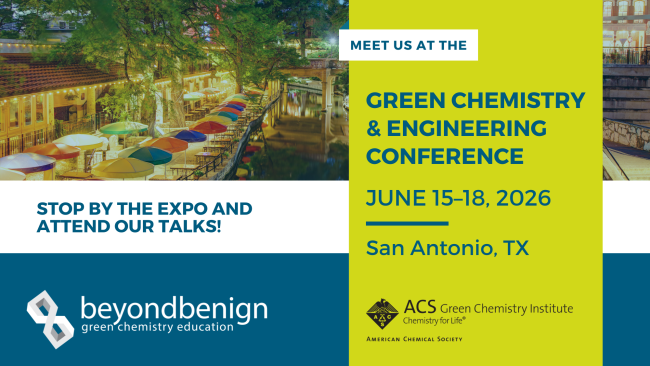
Members of the Beyond Benign team and community will be at the 30th Annual Green Chemistry & Engineering Conference (GC&E) in San Antonio, Texas, this June! Hosted by the American Chemical Society Green Chemistry Institute, this year’s conference will center on the theme "Building the Future: Sustainable Chemistry for Industry, Innovation, and Infrastructure." To connect with our team and community, add our green chemistry presentations and workshops to your agenda, find us at booth #13 in the expo, and, if your institution is a Green Chemistry Commitment (GCC) signer, join our in-person GCC Summit. We look forward to seeing you there!
🌱 Green Chemistry Commitment Signers: Join 2026 GCC Summit
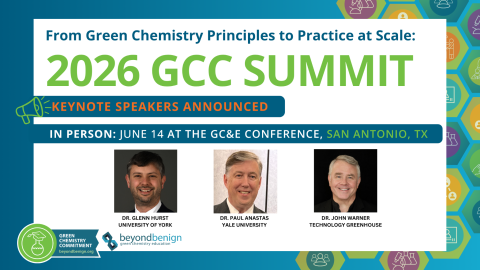
If your institution is a Green Chemistry Commitment (GCC) signer and you are attending the conference, please join Beyond Benign for our in-person GCC Summit, taking place on June 14th during the GC&E. All GCC signers with accounts in the Green Chemistry Teaching and Learning Community (GCTLC) will receive a registration link. If you have not yet received your invitation, reach out to [email protected] for support.
Plus, join our Welcome Networking Reception for Students and Faculty at 6:30 p.m. following the GCC Summit.
🗓️ Add Our Green Chemistry Presentations to Your Calendar
Monday, June 15th (Pre-Conference)
Best Practices in Teaching Green Chemistry: A Workshop for Instructors
Organized by Dr. David Laviska (American Chemical Society Green Chemistry Institute), Dr. Sarah Prescott (University of New Hampshire), Dr. Jennifer Tripp (University of San Francisco), Dr. Tom Umile (Villanova University), and Dr. Alexey Leontyev (North Dakota State University).
This full-day workshop helps science instructors incorporate the principles of green and sustainable chemistry and engineering into their curricula. The agenda covers four topic areas: systems thinking, faculty mentoring networks, case studies in the classroom, and assessments relevant to green and sustainable chemistry. Beyond Benign’s contribution focuses on developing and using case studies to highlight green chemistry principles in real-world classroom contexts, which will be presented by Dr. Tom Umile and Dr. Jennifer Tripp as part of the full-day workshop.
🗓️ June 15th | 8 a.m.-5 p.m. CT
📍Room TBD - Marriott Rivercenter
Frontlines of Innovations: Green Chemistry for Resilient Communities
Presented by workshop organizers Dr. Laurel Royer (Carnalis Consulting), Dr. Loyd Bastin (Widener University), Dr. Monica Hensley (Beyond Benign), Dr. Sederra Ross (American Chemical Society Green Chemistry Institute), and Dr. Mahlet Gardew (AAAS Fellows).
Green chemistry is more than a scientific framework; it is a pathway to equity and resilience. This workshop explores how green chemistry can serve as a tool for reducing toxic exposures and improving health outcomes in communities disproportionately burdened by pollution and environmental hazards. Through real-world case studies, storytelling, and interactive dialogue, the session will examine how chemists can partner with frontline and fenceline communities to inform research priorities, shape safer product design, and support community-driven solutions.
🗓️ June 15th | Time TBD
📍 Room TBD - Marriott Rivercenter
Tuesday, June 16th
Green Chemistry Case Studies in the Undergraduate Curriculum
Dr. Tom Umile (Villanova University), Dr. Jennifer Tripp (University of San Francisco), Dr. Monica Hensley (Beyond Benign), and Dr. David Laviska (American Chemical Society).
This symposium features examples of green chemistry case studies used by educators alongside real-world examples from industry experts. The session supports the American Chemical Society Guidelines for Undergraduate Chemistry Programs, which encourage case-study pedagogy to connect chemistry content with environmental, health, regulatory, and business considerations influencing chemical processes and product design.
🗓️ June 16th | 2-6 p.m.
📍 Salon L — Marriott Rivercenter
Making the Case for Soybeans: Sustainable Solutions for Industrial Applications
Dr. Jane E. Wissinger (University of Minnesota), Dr. Michael T. Wentzel, and Dr. Monica Hensley (Beyond Benign).
This presentation introduces a series of case studies built on soy chemistry that connect chemistry concepts with sustainable industrial applications. Topics include safer and more resilient electrical transformers, recycled asphalt, hydrogenated oils for candle wax, and biobased adhesives for wood, with examples adaptable across general, organic, biochemistry, materials, and environmental chemistry courses.
🗓️ June 16th | 2:25-2:45 p.m.
📍 Salon L — Marriott Rivercenter
💬 Green Chemistry and Engineering Poster Session & Reception
This conference-wide poster session and reception on June 16th from 6-8:10 p.m. in Salon H at the Marriott Rivercenter includes multiple Beyond Benign-affiliated posters highlighting green chemistry education, institutional change, expert engagement, and global resource-sharing through the Green Chemistry Teaching and Learning Community. Check out the list of posters from our community:
Institutionalizing Change for a Sustainable Future: A Commitment to Green Chemistry
Dr. Juliana Vidal, Dr. Michelle Duarte, Dr. Omar Villanueva, and Dr. Amy Cannon (Beyond Benign).
This poster presentation centers on the Green Chemistry Commitment and the institutional pathways through which Beyond Benign supports lasting change in higher education. It highlights how institutions can embed green chemistry across curricula, laboratories, and broader campus systems to advance sustainable chemistry education.
🗓️ June 16th | 6-8 p.m.
📍 Salon H — Marriott Rivercenter, Poster #93
Engaging Experts to Promote Sustainable Chemistry
Dr. Francesca Kerton (Memorial University of Newfoundland) and Dr. Juliana Vidal (Beyond Benign).
This poster presentation explores expert-engagement strategies that support sustainable chemistry education and practice. The work highlights how collaboration with field experts can help strengthen green chemistry learning, expand professional connections, and support broader adoption of sustainable chemistry approaches.
🗓️ June 16th | 6-8 p.m.
📍 Salon H — Marriott Rivercenter
Green Chemistry Teaching and Learning Community (GCTLC): Accelerating the Adoption of Green Chemistry Education and Teaching Practice Across the World
Dr. Jonathon Moir, Dr. Sarah Kennedy, Dr. Alisha Szozda, Dr. Omar Villanueva, and Dr. Amy Cannon (Beyond Benign).
This poster presentation highlights the Green Chemistry Teaching and Learning Community (GCTLC), a global hub for resource sharing and educator collaboration developed by Beyond Benign in partnership with the American Chemical Society Green Chemistry Institute. The poster explores how the platform is accelerating the adoption of green chemistry education and teaching practice across the world.
🗓️ June 16th | 6:10-8:10 p.m.
📍 Salon H & I — Marriott Rivercenter
Wednesday, June 17th
Green Chemistry Resources in the Classroom and Laboratory — Part 1
Dr. Kendra Denlinger (Xavier University), Dr. Richard Mullins (Xavier University), Dr. Monica Hensley (Beyond Benign), and Dr. David Laviska (American Chemical Society).
This symposium showcases practical green chemistry resources educators can use across general, organic, and upper-level chemistry classes, including resources developed by Beyond Benign, the American Chemical Society Green Chemistry Institute, the Green Chemistry Teaching and Learning Community, and others. Speakers will share what they are using, why it matters, and how educators can take actionable steps toward both major curriculum changes and small first shifts.
🗓️ June 17th | 9:30 a.m.-12:30 p.m.
📍 Salon D — Marriott Rivercenter
Green Chemistry Professional Mentoring Networks: A New Five-Year NSF-Funded Program to Advance the Adoption and Implementation of Green Chemistry Curriculum Materials
Dr. Jonathon Moir (Beyond Benign), Dr. Monica Hensley (Beyond Benign), Dr. Nikita Burrows (Monmouth University), Dr. Omar Villanueva (Beyond Benign), and Dr. Amy Cannon (Beyond Benign).
This presentation introduces Beyond Benign’s five-year, $1.8 million National Science Foundation-funded Green Chemistry Professional Mentoring Networks program, which supports up to 160 faculty and educational practitioners through thematically focused mentoring groups. Participants receive peer mentorship, access to green chemistry experts, professional development time, a stipend, travel support to an in-person summit, and curriculum development funds. The talk will share the program overview, research framework, and initial outcomes to date.
🗓️ June 17th | 9:55-10:15 a.m.
📍 Salon D — Marriott Rivercenter
Teaching the Future: Education, Belonging, and the Next Era of Green Chemistry
Dr. Juliana Vidal (Beyond Benign).
This invited fireside-chat-style session explores how the future of green chemistry will be shaped not only by new molecules and materials but also by education, community, and who feels empowered to participate in the field. Drawing on Dr. Vidal’s research background in waste valorization and biorefinery approaches and her leadership at Beyond Benign, the conversation invites attendees to consider how green chemistry can become a lived practice through curriculum, mentorship, and collective action.
🗓️ June 17th | 9:55-10:15 a.m.
📍 Salon J — Marriott Rivercenter
Working in Partnership for International Green Chemistry Education
Dr. Glenn Hurst, University of York) and Dr. Juliana Vidal (Beyond Benign).
This presentation explores how international partnerships can support the global adoption of green chemistry instruction across diverse social, environmental, and economic contexts. The speakers will share examples of effective partnership models and discuss how intentional, systems-based collaboration can make green chemistry education more accessible, scalable, and effective.
🗓️ June 17th | 11:10-11:30 a.m.
📍 Salon D — Marriott Rivercenter
Green Chemistry Resources in the Classroom and Laboratory — Part 2
Dr. Kendra Denlinger (Xavier University), Dr. Richard Mullins (Xavier University), Dr. Monica Hensley (Beyond Benign), and David Laviska (American Chemical Society).
This afternoon continuation of the symposium covers faculty perspectives on core green chemistry competencies, the American Chemical Society Green Chemistry Institute’s new Fundamentals of Green Chemistry professional development course, engineering perspectives on bridging green chemistry education and practice, and several greener-laboratory case studies.
🗓️ June 17th | 2-5 p.m.
📍 Salon D — Marriott Rivercenter
Shared Chemical Hazard Data as an Accelerator for Safer Substitution and Green Chemistry Decision-Making
Heather McKenney (ChemFORWARD), Dr. Mike Delee (Dow Chemical Company), Sara Farahmand (The Honest Company), Dr. Monica Hensley (Beyond Benign), and Dr. Amy Cannon (Beyond Benign).
This presentation highlights the Chemical Hazard Data Trust, a public-interest asset managed by ChemFORWARD that provides standardized, peer-reviewed GHS-based chemical hazard assessments to support safer chemical selection. The talk will explore how shared hazard data can help identify safer functional alternatives, promote verified safer materials, and support hazard-based metrics, including its use as an educational tool in Beyond Benign Green Chemistry Commitment signatory classrooms.
🗓️ June 17th | 2:25-2:45 p.m.
📍 Salon K — Marriott Rivercenter
Incorporating Systems Thinking and the UN SDGs into an Online GOB Second Semester Lab
Dr. Cynthia Woodbridge (Georgia Gwinnett College) with Dr. Omar Villanueva (Beyond Benign).
This presentation shares examples from Georgia Gwinnett College’s work to update the online lab portion of an Organic-Biochemistry course by integrating systems thinking, green chemistry, and the UN Sustainable Development Goals. The session will highlight selected adaptations designed to make online lab activities more engaging, meaningful, and connected to broader sustainability learning outcomes.
🗓️ June 17th | 4:20-4:40 p.m.
📍 Salon D — Marriott Rivercenter
Development of an Online Green Chemistry Professional Development Course
Dr. Monica Hensley, Dr. Amy Cannon, and Dr. Omar Villanueva of Beyond Benign, alongside Dr. Jaime Curtis-Fisk, Melissa Schisler, Dr. Nesta Bortey-Sam, and Dr. Douglas Raynie.
This poster presentation highlights the development of an online green chemistry professional development course. The presentation reflects Beyond Benign’s ongoing work to expand accessible professional learning opportunities that support educators in bringing green chemistry principles, resources, and practices into their teaching.
🗓️ June 17th | 6-8:30 p.m.
📍 Salon G — Marriott Rivercenter, Poster #11
Thursday, June 18th
Building a Sustainable Molecular Foundation Through Green Chemistry Innovation and Education
Beyond Benign Co-Founders Dr. John Warner and Dr. Amy Cannon.
This presentation frames Beyond Benign’s vision for building a sustainable molecular foundation through green chemistry innovation and education. It discusses the Technology Greenhouse and the Green Chemistry Commitment as global initiatives driving systemic change in how chemistry is taught, practiced, and connected to industry. The talk anchors a broader session on chemistry for the future by exploring how education and innovation pipelines can move basic science toward real-world impact.
🗓️ June 18th | 2:05-2:45 p.m.
📍 Salon J — Marriott Rivercenter
San Antonio, TX
United States