Event
Event Description
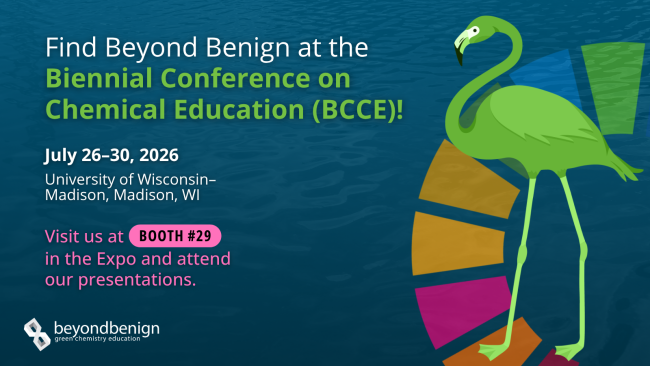
Members of the Beyond Benign team and community will be at the Biennial Conference on Chemical Education (BCCE)! If you are attending the conference at the University of Wisconsin-Madison, visit us at booth 29 in the Expo and join us for green chemistry programming. Here’s our schedule:
Sunday, July 26
Building Skills for the Future: A Workshop on Integrating Green and Sustainable Chemistry into Undergraduate Teaching Laboratories
Organized by Dr. Jonathon Moir (Beyond Benign), Dr. David Laviska (ACS Green Chemistry Institute), Dr. Jane Wissinger (University of Minnesota), and Dr. John De Backere (University of Toronto)
This workshop engages educators in integrating green chemistry as a framework for teaching fundamental chemical concepts through a lens of sustainability, while emphasizing peer-to-peer learning and mentorship within communities of practice. Participants will explore approaches to developing modern laboratory curricula that reflect current industrial practices, guided by experienced facilitators.
🗓️ Sunday, July 26 | 10:30 a.m.–12 p.m. and 3:30–5 p.m.
📍 Chemistry: 1357/1359
Monday, July 27
From Ideation to Assessing Impact: The Green Chemistry Teaching and Learning Community (GCTLC) as a Global Community of Practice
Presented by Dr. Jonathon Moir (Beyond Benign); co-authored by Tyler Schisler, Dr. Sarah Kennedy, Dr. Alisha Szozda, Dr. Omar Villanueva, and Dr. Amy Cannon (Beyond Benign)
This presentation will describe the overall lifespan and development of the Green Chemistry Teaching and Learning Community (GCTLC) to date, from initial ideation in 2020 and collaborative development of the various components of the site to the current state of the platform and its future growth and trajectory. Such an overview can inform conference attendees of the opportunities and pitfalls of starting an online platform to support a global Community of Practice (CoP), highlight how assessment of impact reveals community member interests and can help adjust course, and, importantly, reveal the impact that the GCTLC as a CoP has already had on its members and the community at large.
🗓️ Monday, July 27 | 11:15–11:35 a.m.
📍 Engineering Hall 2535
An Easy-to-Use Template for Creating Custom Case Studies Focused on Green Chemistry and Sustainability
Presented by Dr. Jennifer Tripp (University of San Francisco) and Dr. Tom Umile (Villanova University); co-authored by Dr. Monica Hensley (Beyond Benign), Dr. David Laviska (ACS Green Chemistry Institute), and Dr. Amy Cannon (Beyond Benign)
This poster presents a versatile template that guides instructors in building their own effective case studies for classroom use—helping them select a suitable real-world example, identify connections to green and sustainable chemistry, write effective learning objectives, and create course materials, including activities, slides, and assessments. The template allows instructors to create a complete curriculum package that can be shared with others, leading to broader impact across the chemistry educator community.
🗓️ Monday, July 27 | 2-3:30 p.m. (interactive) and 5:30–8:30 p.m. (open viewing)
📍 Main Lounge
Advancing Green Chemistry in Higher Education Through the GCC Program
Presented by Dr. Michelle Duarte (Beyond Benign); co-authored by Dr. Juliana Vidal, Dr. Omar Villanueva, and Dr. Amy Cannon (Beyond Benign)
Beyond Benign’s Green Chemistry Commitment (GCC) program supports institutions with tools to integrate green chemistry into higher education, promote systemic, long-lasting change, and foster a global community of practice. To date, the GCC accounts for over 270 institutions across more than 37 countries, impacting 1.6+ million students annually. This poster presents results from the 2025 annual audit and survey, highlighting how the program's resources, community, and guidance facilitate institutional integration of green chemistry, with comparisons to previous data illustrating long-term impact and evolving adoption strategies.
🗓️ Monday, July 27 | 5:30–8:30 p.m. (open viewing)
📍 Main Lounge
Development and Implementation of an On-Demand Introductory Course to Infuse Green Chemistry in the Undergraduate Curriculum
Presented by Dr. Deborah Bromfield Lee (Florida Southern College); co-authored by Dr. Monica Hensley (Beyond Benign)
This presentation outlines the development and implementation of an on-demand introductory course in green chemistry for Beyond Benign, structured into four comprehensive parts and hosted on the Green Chemistry Teaching and Learning Community (GCTLC). The course design draws on current literature, peer collaboration, community feedback, and alignment with educational standards—equipping faculty to educate undergraduate students with the knowledge and skills to apply green chemistry principles and promote sustainability and environmental stewardship in the chemical sciences.
🗓️ Monday, July 27 | 4:15– 4:35 p.m.
📍 Engineering Hall 1800 (within S45c)
Examining the Integration of Cosmetic Chemistry Into the Chemistry Curriculum
Presented by Natalie Gil-Arcos (Monmouth University); co-authored by Dr. Monica Hensley (Beyond Benign) and Dr. Nikita Burrows (Monmouth University);
This research presents a systematic literature review of 60 peer-reviewed academic articles on cosmetic chemistry education published since 1939. The focus of this review is to establish how cosmetic chemistry topics are being integrated into chemistry classrooms and labs to understand how applied-chemistry courses can impact students’ learning and motivations toward chemistry and its ability to foster awareness of potential careers within the discipline. The findings of this literature review can serve as a useful guide for chemistry instructors and education researchers, as it underscores the value of integrating applied chemistry experiments and courses to connect fundamental concepts of industry, green chemistry, and real-world applications to the classroom.
🗓️ Monday, July 27 | 5:30– 8:30 p.m.
📍 Main Lounge (open viewing)
Tuesday, July 28
Case Studies of Green Chemistry in the Classroom
Chaired by Esther Hines (Billerica Memorial High School, retired) and Dr. Jennifer Tripp (University of San Francisco); organized with Dr. Tom Umile (Villanova University), Dr. David Laviska (ACS Green Chemistry Institute), and Dr. Monica Hensley (Beyond Benign).
This session highlights the diverse ways chemical educators at all levels have employed case study-based lessons in their classrooms—from high school through graduate level—and includes a moderated discussion to foster networking, sharing of ideas and course materials, and community building. The American Chemical Society Green Chemistry Institute and Beyond Benign recently co-developed a case study template and guide to assist instructors in developing their own case study-based lessons.
🗓️ Tuesday, July 28 | 8:30–10 a.m.
📍 Engineering Hall 1800
Understanding Chemistry as both the Problem and Solution to Human and Environmental Health Challenges through the Implementation of Case Studies in a Green Chemistry Course
Presented by Dr. Amy Cannon (Beyond Benign)
This presentation shares how case studies were used in a green chemistry course to provide context and understanding of the challenges and opportunities our field faces. Case studies highlighting U.S. Superfund sites bridged historical impacts of the chemical industry to concepts such as toxicology, epidemiology, and greener chemical design. Toxicology case studies taught key concepts and provided students with tools for greener chemical design, equipping them to contribute to a future in which chemistry addresses environmental and human health challenges without repeating past mistakes.
🗓️ Tuesday, July 28 | 8:35–8:55 a.m.
📍 Engineering Hall 1800 (within S158a)
Bridging Academia and Industry: Defining Green and Sustainable Chemistry Skills for the Future Workforce
Moderated by Dr. Amy Cannon (Beyond Benign), featuring Jeffrey Whitford (MilliporeSigma), Dr. Victor Ramos Sanchez (Northern Arizona University), and Dr. Mary Carroll (Union College)
This community conversation brings together academics and industry professionals to define the green and sustainable chemistry competencies that matter most for the future workforce. Co-organized with MilliporeSigma, the U.S. and Canada Life Science business of Merck KGaA, Darmstadt, Germany, the session explores how institutions can better align chemistry education with real-world industry needs—ensuring graduates are equipped with the knowledge and skills to advance sustainable chemistry in professional settings.
🗓️ Tuesday, July 28 | 6-7 p.m.
📍 Memorial Union: Play Circle (2190)
Advances in Research and Practice on Sustainability in the Lab
Organized by Dr. Nikita Burrows (Monmouth University), Dr. Mary Ross (Georgia Gwinnett College), and Dr. Monica Hensley (Beyond Benign)
This symposium highlights current research and innovative practices in sustainable laboratory chemistry. Presentations explore how educators and researchers are implementing greener approaches in teaching and research labs across a range of institutional contexts.
🗓️ Tuesday, July 28 | 3:30–5 p.m.
📍 Engineering Hall 1800
Green Chemistry Education for a Sustainable Future: Sharing Ideas and Building Community
Chaired by Cecilia Smith (ACS Green Chemistry Institute) and Dr. Omar Villanueva (Beyond Benign)
A lightly facilitated conversation for attendees interested in advancing green chemistry education in their courses, programs, and institutions. Co-hosted by Beyond Benign and the American Chemical Society Green Chemistry Institute, the session will create space to share specific resource examples—from small changes in a single lab or lesson to broader program-level efforts—and to learn from what others are trying in different contexts.
🗓️ Tuesday, July 28 | 7–8 p.m.
📍 Memorial Union: Profile (2318)
Wednesday, July 29
Advances in Research and Practice on Sustainability in the Lab (continued)
Organized by Dr. Nikita Burrows (Monmouth University), Dr. Mary Ross (Georgia Gwinnett College), and Dr. Monica Hensley (Beyond Benign)
This symposium invites qualitative and quantitative research, as well as teaching-focused contributions, centered on undergraduate chemistry laboratory courses with a focus on green chemistry and sustainability, systems thinking, and safety. In alignment with the updated American Chemical Society Guidelines, the session welcomes studies on lab curriculum and experiment design, instructional strategies at the bench, and student engagement.
🗓️ Wednesday, July 29 | 8:30–10 a.m.
📍 Engineering Hall 1800
Writing Green Chemistry Case Studies
Organized by Dr. Jennifer Tripp (University of San Francisco), Dr. Tom Umile (Villanova University), Dr. Monica Hensley (Beyond Benign), and Dr. David Laviska (ACS Green Chemistry Institute)
In this interactive workshop, educators will collaboratively work through a versatile Case Study Template to begin building their own case study for classroom use. Participants will also learn how to share case studies through the Green Chemistry Teaching and Learning Community (GCTLC) to build a broader community of practice. Bring a laptop or another device for writing and online searching!
🗓️ Wednesday, July 29 | 8:30 a.m. – 12 p.m.
📍 Chemistry: 2401
Green Chemistry Education for a Sustainable Future
Presented by Dr. Monica Hensley; coauthored with Dr. Omar Villanueva and Dr. Amy Cannon (Beyond Benign)
Beyond Benign has developed a comprehensive, faculty-driven model to support the integration of green chemistry into undergraduate curricula. Through the creation of open-access curricular resources, developed in collaboration with higher education faculty and informed by industry expertise, combined with targeted professional development programs, Beyond Benign empowers educators to embed sustainability meaningfully into chemistry education.
🗓️ Wednesday, July 29 | 11:35–11:55 a.m.
📍 Engineering Hall 1800 (Symposium presented in: Educating for Sustainability in a Climate-Challenged World)
Thursday, July 30
Sustainability in Practice: Institutional Approaches to Advancing Green Chemistry Education
Chaired by Dr. Omar Villanueva (S337a) and Dr. Michelle Duarte (S337b) (Beyond Benign); co-organized with Dr. Loyd Bastin (Widener University)
As demand for sustainable chemical solutions continues to grow and new accreditation guidelines emerge, higher-education institutions worldwide are seeking effective ways to integrate green chemistry principles into their teaching, research, and departmental practices. This symposium invites faculty and educators to share strategies for driving systemic and institutional change through curriculum design, laboratory transformation, and research-led teaching.
🗓️ Thursday, July 30 | 8:30 a.m. – 12 p.m.
📍 Engineering Hall 1800
Green Chemistry for Non-Science Majors: Development and Implementation of a Physical Science Course
Presented by Dr. Omar Villanueva (Beyond Benign) and co-authored by Dr. Cynthia Woodbridge (Georgia Gwinnett College)
This presentation highlights the design, development, and implementation of a fully online, asynchronous Physical Science course at Georgia Gwinnett College centered on green chemistry for non-science majors. The course reframes core topics—atomic structure, chemical reactions, energy, materials, and environmental systems—through the 12 Principles of Green Chemistry and systems thinking, helping students connect chemistry to real-world decisions and societal challenges.
🗓️ Thursday, July 30 | 10:35–10:55 a.m.
📍 Engineering Hall 1800 (within S337b)
Supporting Institutional Approaches for Advancing Green Chemistry Education in Brazil Through Beyond Benign’s Green Chemistry Commitment Program
Presented by Dr. Juliana Vidal (Beyond Benign); co-authored by Dr. Michelle Duarte, Dr. Omar Villanueva, and Dr. Amy Cannon (Beyond Benign)
This presentation highlights how the Green Chemistry Commitment (GCC) program is supporting Brazil's growing network of GCC signers (now 22 institutions, the third-largest globally). It explores how regional collaboration, understanding local needs and misconceptions, and international network support can move green chemistry adoption from isolated efforts to a unifying, transferable framework.
🗓️ Thursday, July 30 | 8:35 – 8:55 a.m.
📍 Engineering Hall 1800 (within S337a)
Find more green chemistry and sustainability programming here.
University of Wisconsin–Madison
500 Lincoln Dr
Madison, WI 53706
United States