Green Chemistry
International Symposium on Green Chemistry

Event Date
-
Event Type
Hosting Organization(s)
Centre national de la recherche scientifique (CNRS)
Additional Host Organizations
International Symposium on Green Chemistry
Event Description
Join the global movement in sustainable chemistry innovation!
The International Symposium on Green Chemistry (ISGC 2025), scheduled for May 12-16, 2025 in La Rochelle, France, is one of the world’s leading events in sustainable chemistry research and innovation. This global event is a cornerstone for advancing sustainable chemistry, bringing together academia, industry leaders, startups, and innovators from around the world.
Featuring over 320 speakers, cutting-edge plenary sessions, and innovative startups, it offers an unparalleled opportunity to connect and collaborate on advancements in green chemistry. Topics to be covered are:
- Biomass conversion
- Waste and side streams valorization
- Homogenous, Heterogeneous and Biocatalysis
- Polymers or composites
- Alternative solvents
- Alternative technologies such as microwaves, plasma, ultrasound, mechanochemistry, photochemistry, electrochemistry, etc.
- Clean reactions such as tandem and cascade reactions, one-pot reactions, multicomponent reactions, etc.
- Chemical engineering
- Industrial chemistry
- Energy such as hydrogen, energy storage, batteries, biofuels, solar cells, etc.
- Mechanism investigations
- Artificial intelligence
- Life cycle and environmental assessment
- Networking and education
The event also includes a 3,500 m² exhibition area, showcasing technologies and solutions that pave the way for a sustainable future. Don't miss your chance to be part of this milestone in chemistry innovation.
To learn more, visit ISGC Symposium Website (https://www.isgc-symposium.com/). Don't miss your chance to be part of this milestone in Greener Chemistry innovation!
More Information About Event
Event Registration
Event Format
Event Address
Espace Encan
Quai Louis Prunier
17033 La Rochelle
France
Intended Audience
Green Chemistry as the Foundation of Sustainability and the Circular Economy

Event Date
-
Event Type
Hosting Organization(s)
Merck Life Science Srl
Event Description
While there is a lot of discussion about WHY we need sustainability (Climate Change, Forever Chemicals, Human Toxicity, Ecosystem Degradation…) and WHAT we should do to measure and characterize sustainability (LCA’s, UN SDGs, Circular Economy, Safe and Sustainable by Design, Planetary Boundaries…) It is especially important to discuss HOW we should make these changes. This is the domain of Green Chemistry.
When a researcher contemplates a new experiment, when an inventor imagines a new product, he or she makes several small and large decisions that will have profound impact on the ultimate sustainability of what they do. If they do not have the skills and tools to understand the sustainability implications at the mechanistic molecular level (green chemistry), it is unlikely that they will successfully achieve sustainability objectives. This presentation will discuss how green chemistry can be integrated into the earliest stages of research and development to ensure maximum sustainability. Real world, commercialized examples will be used to illustrate key points.
In this webinar, you will learn:
- The Why’s and the What’s of sustainability are important, but solutions come from How (green chemistry).
- It is not enough to simply WANT to create sustainable technologies, there are certain critical skills required, as defined by the 12 principles of green chemistry.
- Not only does green chemistry have moral and ethical implications, but it is also a pathway to accelerate R&D and lower costs. (If you truly understand green chemistry).
- Several commercialize products illustrate the reality of green chemistry’s successful implementation in the real world.
Speaker:
John C. Warner
CEO & CTO, Technology Greenhouse, LLC
John Warner is one of the founders of the field of green chemistry. He wrote the book that provides the definition and 12 principles of green chemistry with Paul Anastas in 1998.He received his B.Sc. from UMASS Boston and his PhD from Princeton University.As an industrial chemist, he has over 350 patents and has worked with hundreds of companies worldwide and serves on the sustainability advisory boards of several multinational companies. He received the Perkin Medal in 2014 from The Society of Industrial Chemistry.As an educator, he was a tenured full professor of chemistry and a tenured full professor of plastics engineering at the University of Massachusetts where he started the world’s first PhD program in Green Chemistry. He has over 120 publications in synthetic methodologies, noncovalent derivatization, polymer photochemistry and metal oxide semiconductors. In 2004 he received the Presidential Award for excellence in science mentoring (PAESMEM) from the US National Science Foundation (NSF) and President George W Bush and in 2022 he received the August Wilhelm von Hofmann Medal from the German Chemical Society. In 2007 he cofounded Beyond Benign, a nonprofit green chemistry education organization with Dr. Amy Cannon.As an entrepreneur, John’s inventions have led to the founding of many companies in the fields of photovoltaics, neurochemistry, construction materials, water harvesting and cosmetics. In 2016 he received the Lemelson Invention Ambassadorship from the Lemelson Foundation and the American Association for the Advancement of the Sciences (AAAS).
More Information About Event
Event Registration
Event Format
Intended Audience
Modern Approaches to High School Chemistry Instruction Through Today’s Sustainability Challenges
Event Date
-
Event Type
Lead Organizers
Hosting Organization(s)
University of Minnesota
NSF Center for Sustainable Polymers
Additional Host Organizations
UMN MRSCEC Research Experience for Teachers
Event Description
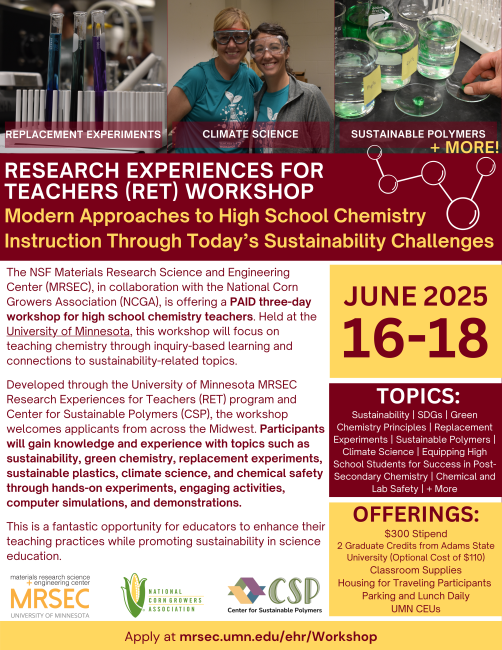
The NSF Materials Research Science and Engineering Center (MRSEC), in collaboration with the National Corn Growers Association (NCGA), is offering a PAID three-day workshop for high school chemistry teachers. Held at the University of Minnesota, this workshop will focus on teaching chemistry through inquiry-based learning and connections to sustainability-related topics.
Developed through the University of Minnesota MRSEC Research Experiences for Teachers (RET) program and Center for Sustainable Polymers (CSP), the workshop welcomes applicants from across the Midwest. The workshop is in-person only.
Participants will gain knowledge and experience with topics such as sustainability, green chemistry, replacement experiments, sustainable plastics, climate science, and chemical safety through hands-on experiments, engaging activities, computer simulations, and demonstrations.
This is a fantastic opportunity for educators to enhance their teaching practices while promoting sustainability in science education.
More Information About Event
Event Format
Event Address
207 Pleasant St SE
Minneapolis, MN 55455
United States
Intended Audience
Canadian Chemistry Conference and Exhibition (CSC 2025)
Event Date
-
Event Type
Event Description
Canadian Chemistry Conference and Exhibition is the premier conference for the Canadian Society for Chemistry. The mission of the chemistry conference is to be your forum; a venue where you can embrace learning, exchange knowledge, build innovative ideas, advance your career, and advance the chemistry profession.
Taking part in the Canadian Chemistry Conference and Exhibition is an opportunity to grow, learn, connect, and celebrate all that Canadian chemistry has to offer.
This is the first year of the inaugural Green Division and there will be tons of green chemistry-related symposia and workshops throughout the conference!! Several will be led by Beyond Benign team members! Read more about them here.
--
Beyond Benign Talks
Green and Sustainable Practices in Chemistry Education (CE/GC)
Barb Morra, University of Toronto; Jonathon Moir, Beyond Benign; Nimrat Obhi, Beyond Benign; Andrew Dicks, University of Toronto; Olivia Mann-Delany, University of Toronto
--
Chemistry education plays a critical role in training the next generation of chemists and engineers to consider the holistic impact of their work and actively explore ways to use more sustainable practices. This session aims to explore how educators can integrate green and sustainable chemistry practices into their classrooms, teaching laboratories, and programs. The session will be split into two parts: oral presentations followed up a workshop.
Part 1 (what are others doing with green chemistry in education?): This component will bring together instructors, teaching assistants, technical staff, and other educational stakeholders and provide them with a platform to showcase the creative ways they incorporate green and sustainable practices into their departments and curricula. Participants are encouraged to provide their unique perspective into the development, implementation, and learning outcomes of their pedagogical work, while considering how their efforts could be adopted by other instructors, particularly those with limited resources or experience with green and sustainable practices.
Part 2 (how can I add more green chemistry to my teaching?): The second part of the session will involve a workshop that provides an opportunity for educators to learn how to further adapt and implement more green and sustainable concepts into their own classrooms and laboratory using a guided inquiry approach. Workshop participants will work in small groups with facilitators to explore simple and effective approaches to updating their existing course/laboratory content and establish action plans toward implementation.
Bringing Green Chemistry into Your Lab – A Workshop for Graduate Students and Postdoctoral Fellows (GC)
Tuesday, June 17th from 8:00-11:40am in room 203 at the Rogers Center Ottawa
Jonathon Moir, Beyond Benign; Juliana Vidal, Beyond Benign; Nimrat Obhi, Beyond Benign; Barb Morra, University of Toronto; David Laviska, ACS GCI; Galen Yang, McGill University; Shauna Schechtel, Queen’s University
--
Research laboratories are some of the most energy and resource intensive spaces on university and college campuses. They generate large amounts of both hazardous and non-hazardous waste (including solvents, reagents, solids, glassware, filter paper, drying agents, disposable gloves, and column waste) daily. However, this is often considered a necessary evil and an acceptable price to pay to make innovative discoveries for the betterment of humanity. Fortunately, this does not need to be the case; research in higher education can be done in a way that allows for discovery and innovation to take place without generating large amounts of waste and subjecting students, postdoctoral fellows and researchers to hazardous compounds and laboratory conditions. Importantly, there are many safer alternative reagents, solvents, and laboratory materials that can be used to reduce risk of exposure. This approach, known as green chemistry, utilizes a set of twelve practical principles for research and bench chemists to help reduce the use and generation of hazardous substances for humans and the environment.
This workshop introduces green chemistry and how its associated twelve principles can be applied at the graduate and postdoctoral level in research laboratories across universities and colleges in Canada. The workshop will explore examples of how green chemistry has been successfully introduced into research labs in different subdisciplines of chemistry and will provide an opportunity for participants to work in small groups through guided discussions to identify ways of improving their own laboratory practices and research to shift towards greener and more sustainable practices.
More Information About Event
Event Format
Event Address
ON
Canada
Intended Audience
Entrepreneurship Panel Discussion “Learning from Green Chemistry Entrepreneurs”
Event Date
-
Event Type
Hosting Organization(s)
International Union of Pure and Applied Chemistry
Event Description
This webinar will introduce you to three leaders in the field of green chemistry and their stories related to start-ups in this sector: Dr. John Warner, Prof. Philip Jessop, and Prof. Richard Blackburn.
This panel discussion will aim to answer the following questions:
• 'What are their top two pieces of advice for budding chemistry entrepreneurs?'
• 'What have been the biggest barriers or challenges that they've experienced?'
• 'In their opinion, how can we encourage entrepreneurship, especially in the chemistry community?’
More Information About Event
Event Registration
Senior Project Manager (m/f/d)
DUDE CHEM is a Green Chemistry startup with its origins in the German Cluster of Excellence in Catalysis at the University of Technology Berlin. We are a small but mighty team which is dedicated to fulfil our mission: Based on the 12 Principles of Green Chemistry we aim to build a green chemical-pharmaceutical industry. The industry currently consumes >13% of all fossil resources, most of them during the manufacturing. Our aim is to change this.