Open/Entire Community

Promoting Chemistry Applied to World Needs

Event

Promoting Chemistry Applied to World Needs
Event Date
-
Event Type
Event Format
decorate image

Event Description

Are you an aspiring chemist, a passionate climate advocate, or an interested member of the public? Do you want to change the world through science? Join the IUPAC CHEMRAWN and Beyond Benign throughout 2025 to learn from experts in the field who are leading the charge to solve existential, world needs through chemistry. Speakers will orient their presentations around the United Nations Sustainable Development Goals (UN SDGs), as well as the IUPAC Top 10 Emerging Technologies, to demonstrate the power that chemists hold in shaping, and preserving, the future. 

Each talk will be accompanied by  2-3 minute videos on the topic, for chemistry students in high school, university, and for the general public.


January Webinar 


“From Detoxifying Chemical Warfare Agents to Treating Nuclear Wastewater: Adventures in the Synthesis of Metal–Organic Frameworks” 

Ashlee Howarth, Concordia University

01/24/2025 | 9:00 – 10:00 AM EST


Webinar Description:

Named by IUPAC as one of the “Top 10 Emerging Technologies in Chemistry” in 2019, what can metal-organic frameworks (MOFs) really do? IUPAC CHEMRAWN Committee and Beyond Benign invite you to learn more about MOFs and join the discussion with Prof. Ashlee Howarth from Concordia University! Prof. Howarth is dedicated to using green chemistry principles and practices to design and synthesize rare-earth cluster-based MOFs which can then be applied to clean up wastewater from coal and nuclear power plants, as well as decontaminate military equipment. Other applications investigated by Ashlee also include catalysis, drug delivery, X-ray detection, and chemical sensing applications to solve our current environmental challenges. 


More About Professor Ashlee Howarth:

Ashlee J. Howarth is an Associate Professor and Concordia University Research Chair at Concordia University in Montréal. She was born and raised in London, Ontario. She obtained her undergraduate degree from the University of Western Ontario in 2009, and then went on to do her PhD in inorganic materials chemistry at the University of British Columbia under the supervision of Michael O. Wolf. Before joining the faculty at Concordia, she completed an NSERC Postdoctoral Fellowship at Northwestern University with Joseph T. Hupp and Omar K. Farha. At Concordia, the Howarth group is focused on the design and synthesis of rare-earth cluster-based metal–organic frameworks targeting applications in pollution remediation, catalysis, drug delivery, X-ray detection, and chemical sensing. Ashlee is also the contact point for the Green Chemistry Commitment at Concordia University.


Event Address

United States

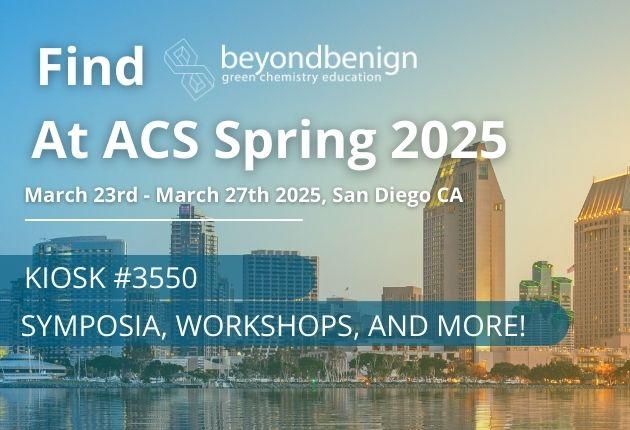
ACS Spring Meeting 2025

Event

ACS Spring Meeting 2025
Event Date
-
Event Type
Event Format
Decorative Image

Event Description

ACS Meetings & Expositions are where chemistry professionals meet to share ideas and advance scientific and technical knowledge. By attracting thousands of chemical professionals, the meetings provide excellent opportunities for sharing your passion for chemistry, connecting with one of the world's largest scientific societies, and advancing your career in this ever-changing global economy.


Mechanisms to Move the Oil and Gas Business to Green Chemistry

Presented by Dr. John Warner, Co-Founder of Beyond Benign; Co-Author of Green Chemistry: Theory and Practice; CEO of the Technology Greenhouse

Sunday, March 23rd from 8:00 - 11:00 AM PST | Marriot Grand Ballroom Section 11


To many people the oil and gas business represents one of the most unsustainable aspects of the chemical enterprises. In many ways this perception is deserved. But in some ways this perspective misses some important social implications. Because our global economy is currently dependent on this industry, we can’t simply decide to just stop overnight. It is going to take a very long time to create alternative technologies that meet the current global demands that the oil and gas business. In parallel to creating alternatives, we have a moral and ethical responsibility to take as many steps as possible to improve the sustainability performance of the myriad integrated processes to this business.. This presentation will discuss the challenges and opportunities that must be addressed as soon as possible.


Green Chemistry and Circular Economy Opportunities for Soft Materials

Presented by Dr. John Warner, Co-Founder of Beyond Benign; Co-Author of Green Chemistry: Theory and Practice; CEO of the Technology Greenhouse

Sunday, March 23rd from 4:20 - 4:25 PM PST | Ballroom 6D


Soft materials provide molecular mechanisms that allow the design of products capable of achieving sustainability goals (green chemistry and circular economy). Unique reversible and irreversible interactions that create flexible molecular architectures provide structural resilience and adaptation in various environments. These systems under dynamic equilibria offer customized product performance and enable circular economic models of reuse. This presentation will discuss examples of noncovalent derivatization and photo crosslinked polymer matrices as bioinspired illustrations of commercially relevant technologies that are consistent with the 12 principles of green chemistry.


Advancing Green Chemistry Education: The Process, Research and New Developments in Curricular Activities

Organized by: Dr. Deborah Bromfield-Lee, Dr. Monica Soma Hensley, & Dr. Jane Wissinger

Wednesday, March 26th from 8:00– 11:00 AM PST | Room 5B


There is an increase in educational activities aimed at enhancing knowledge and use of Green Chemistry principles and applications. However, with demands in academia, this sometimes presents a barrier to wider adoption across the curriculum. This symposium explores the process of developing Green Chemistry activities, courses, and curricular changes, sharing how educators got started and progressed through development. The discussion will cover research, theory-based methodology, and pedagogical strategies used to revamp or develop activities, as well as chemical education research on this process. The session will also discuss the pivotal role of change agents—educators and researchers who drive the adoption of innovative practices and sustainable principles in education. By sharing the developmental journey and the theoretical underpinnings of our assessment strategies, the session aims to contribute to the broader discourse on advancing Green Chemistry education and to inspire ongoing research and implementation of effective teaching methodologies. Speakers from all sectors of the CHED community are invited to share how they are integrating green and sustainable chemistry, systems-thinking, toxicology, and social/environmental justice into their classrooms, laboratory curriculum, undergraduate research and outreach activities. Interdisciplinary and international perspectives are welcome, as are student speakers at the undergraduate, graduate and post-doctoral levels, including those from minority-serving institutions.


Fostering Green Chemistry Education: Enhancing Curricula and Faculty Development through Industry Collaboration and Open-Access Curriculum Development

Presented by Dr. Monica Soma Hensley

Wednesday, March 26th from 10:25 – 10:45 AM PST | Room 5B


The incorporation of green chemistry principles as a decision-making framework into academic curricula is essential for preparing students for sustainable careers in chemistry and related fields. This process requires the development of curricular materials that are both relevant and accessible, as well as a professional development infrastructure to support educators in this endeavor. Beyond Benign, a nonprofit organization focused on green chemistry education, has created a comprehensive framework that fosters faculty development through open-access resource creation and collaborative opportunities with industry experts. One key initiative is the faculty-led, faculty-developed approach to curriculum design, which incorporates industrial expertise to ensure real-world relevance. This partnership exemplifies how industrial collaboration can enhance curricular content, making it more applicable to current industry standards while supporting faculty in their professional growth.

In this presentation, notable case studies will be highlighted to showcase how Beyond Benign promotes collaboration for developing open-access curricular activities, and the impact of these initiatives on faculty development, resource creation, and the broader adoption of green chemistry education across academic institutions. Additionally, findings from a faculty survey highlighting the professional development needs of educators in green chemistry will be shared.


Environmental Justice: Community Engagement, Education and Action Through Green and Sustainable Chemistry and Chemical Engineering

Organized by: Dr. Loyd Bastin, Dr. Edward Brush, Dr. Tsvetanka Filipova, Dr. Nimrat Obhi, Dr. Laurel Royer, and Dr. Jane Wissinger

Thursday, March 27th from 8:00 AM– 12:00 PM PST | Marriott Grand Ballroom: Section 5


This symposium will explore the growing need for the chemistry and chemical engineering enterprises to adopt green chemistry and green engineering principles and practices through the lens of environmental justice. The United States Environmental Protection Agency defines Environmental Justice as the fair treatment and meaningful involvement of all people regardless of race, color, national origin, or income, with respect to the development, implementation, and enforcement of environmental laws, regulations, and policies . . .achieved when everyone enjoys: (1) The same degree of protection from environmental and health hazards, and (2) Equal access to the decision-making process to have a healthy environment in which to live, learn, and work. This symposium will engage a multi-stakeholder, multi-disciplinary discourse of speakers and participants focused on a re-evaluation of our business-as-usual practices through the lens of environmental justice: community groups and organizations, education (especially project-based and/or civic learning with environmental justice communities); careers at the intersection of green chemistry and environmental justice; sustainable chemistry technologies; sustainable engineering; connections to the UN Sustainable Development Goals; climate justice; policy statements; and industrial practices. The symposium will include an open discussion on Strengths, Opportunities, Aspirations and Results for the critical role that environmental justice will play in the chemistry and chemical engineering enterprises because it provides a framework to address global environmental and human health impacts that continue to disproportionately burden communities of color, vulnerable and low-income populations.


Event Address

San Diego, CA
United States

Hosting Organization(s)
American Chemical Society (ACS)
Intended Audience

29th Annual Green Chemistry & Engineering Conference

Event

29th Annual Green Chemistry & Engineering Conference
Event Date
-
Event Type
Event Format
GC&E Conference Banner

Event Description

The GC&E Conference, hosted by the ACS Green Chemistry Institute®, is the premier global event for green chemistry and engineering. As the first and longest-running conference on this topic, GC&E attracts scientists, educators, industry professionals, and advocates to explore advancements, share best practices, inspire innovation, and build community dedicated to sustainable solutions.


Each year, the conference evolves, incorporating new ideas while maintaining its 28-year legacy. Its vision is for green and sustainable chemistry to be integral to all scientific endeavors, providing solutions that balance human well-being with planetary health. For this reason, the 2025 conference theme will be Good Health and Well-Being Through Sustainable Chemistry to align withthe United Nations Sustainable Development Goal 3.

GC&E 2025 will showcase innovative research and cross-cutting topics in green and sustainable chemistry and engineering, with an emphasis on symposia that highlight our theme “Good Health and Well-Being”, such as medical breakthroughs, new technologies, and efforts to eliminate or reduce hazardous chemical pollution promoting longer and healthier lives.


Beyond Benign Talks and Social Events


“Design and development of an on-demand introductory course to infuse green chemistry in the undergraduate curriculum”

Dr. Deborah Bromfield Lee, Professor of Chemistry, Florida Southern College


“Case study on sustainable practices in metal plating for Green Chemistry education”

Dr. Hun Bok Jung, Assistant Professor Department of Physical Sciences, Kingsborough Community College


“An online course for the chemistry education community: empowering educators to bring environmental justice discussions into the classroom”

Dr. Monica Soma Hensley, Content Manager, Beyond Benign


““Soy” What? We’ve “bean” incorporating soybean-based industrial innovations into the chemistry curriculum”

Dr. Jane Wissinger, Professor Emerita, Department of Chemistry, University of Minnesota


"Institutional Change for a Sustainable Future: Beyond Benign and the Green Chemistry Commitment"

Dr. Juliana Vidal, Dr. Amy Cannon,  Dr. Omar Villanueva, and Dr. Natalie O’Neil


"Mechanochemistry and Green Chemistry: A Connection Between Education, Research, and Innovation for a Healthier Planet"

Juliana Vidal, Beyond Benign; James Batteas, Texas A&M University; Francesca Kerton, Memorial University; Isaiah Speight, William & Mary


"Comprehensive survey on the implications of green chemistry and toxicology concepts in chemistry education: An industry and academic perspective"

Nesta Bortey-Sam, University of Pittsburgh


"Development of a green chemistry and toxicology professional development certificate course"

Douglas Raynie, South Dakota State University


"Green Chemistry Resources in the Classroom"

Thomas P. Umile, Villanova University; Jennifer A. Tripp, University of San Francisco; Monica Soma Hensley, Beyond Benign; Amy S. Cannon, Beyond Benign; David Laviska, Green Chemistry Institute, American Chemical Society


Image
Decorative image


Green Chemistry Commitment: Catalysts for Change Reception

Come mix and mingle with Beyond Benign, MilliporeSigma (the U.S. and Canada Life Science business of Merck KGaA, Darmstadt, Germany), and the American Chemical Society Green Chemistry Institute at 6 PM on Sunday, June 22nd, 2025 at Sienna Mercato's rooftop bar, il Tetto.

Embrace the unique opportunity to connect with current leaders in the field of green chemistry and find resources to help lead a sustainable future.
Current green chemistry leaders joining this event include members of industry, as well as faculty members who are signers of Beyond Benign's Green Chemistry Commitment.

Enjoy free food and drinks and unique networking opportunities-- all against the beautiful Pittsburgh skyline at a scenic, award-winning venue.

Who: Chemistry Faculty, Undergraduate and Graduate Students
What: A chance to connect with likeminded young chemistry leaders and influencers in the green chemistry space.
When: Sunday, June 22nd at 6:00 PM EST
Where: il Tetto at Sienna Mercato, 942 Penn Ave, Pittsburgh, PA 15222


Catalyzing Change in Chemistry Education Faculty Luncheon

Join Beyond Benign, MilliporeSigma (the U.S. and Canada Life Science business of Merck KGaA, Darmstadt, Germany), and the American Chemical Society Green Chemistry Institute (ACS GCI) for a free, catered luncheon on June 24th, 2025 at the ACS Green Chemistry and Engineering Conference.


Who: Chemistry faculty, administrators, and student leaders interested in generating departmental support for green chemistry implementation.

What: A lunch panel of faculty members who are leading a systemic change in education through the Green Chemistry Commitment (GCC) at their institutions.

Panel moderators: Dr. Amy Cannon (Executive Director & Co-Founder of Beyond Benign) and Jeffrey Whitford Vice President of Sustainability & Social Business Innovation at MilliporeSigma, will bring their own expertise as green chemistry leaders.

Where: Sterlings 1, 2, & 3

When: Tuesday, June 24th, 2025 at 12:30 PM EDT
The GCC program is a collaborative voice created to unite the higher education chemistry community towards green chemistry principles and practices and further its size, reach, and diversity. Join us to learn all the benefits that the students, faculty, and staff in your department can gain access to when they join the GCC.

Register on the GC&E Website
 

Event Address

Pittsburgh, PA
United States

Ask Me Anything with Dr. Amy Cannon

Event

Ask Me Anything with Dr. Amy Cannon
Event Date
-
Event Type
Event Format
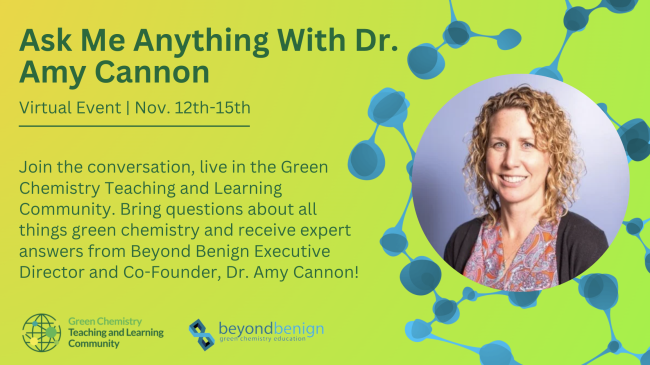
Details for the Ask Me Anything interview event and Amy Cannon's photograph on a lime green and blue background.

Event Description

Join us in the GCTLC forums for an exciting “Ask Me Anything” interview with Dr. Amy Cannon - with you as the interviewers! 


From Nov. 12 to Nov. 15, post any questions for Dr. Cannon in our dedicated forum space. Dr. Cannon will be on hand during this period to answer your questions (time permitting!) – we do hope you will participate. 


Find Dr. Cannon's AMA forum and interview her here!

Event Address

United States

Hosting Organization(s)
Beyond Benign, Inc.
Intended Audience

Green Chemistry Commitment Info Session

Event

Green Chemistry Commitment Info Session
Event Date
-
Event Type
Event Format
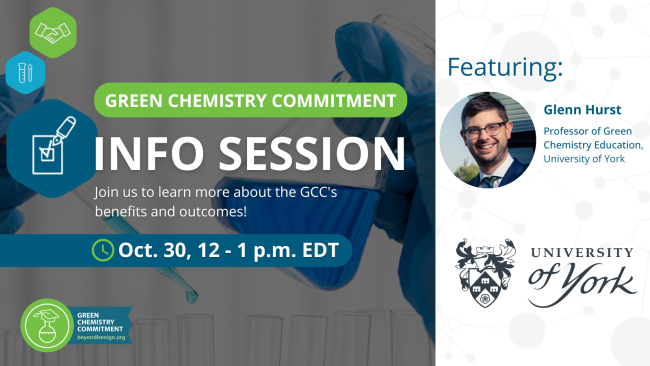
A photo of gloved hands performing a titration sits behind white text reading: Info Session. To the right is an image of a smiling man with brown hair, glasses, and white skin, labeled Glenn Hurst. The University of York Logo sits in the bottom corner.

Event Description

October 30th | 12 - 1 p.m. EDT

Beyond Benign is excited to invite all educators, students, and staff from higher education institutions to a Green Chemistry Commitment (GCC) Info Session on October 30th, 2024. At this virtual session, we will hear from Glenn Hurst, a Professor of Green Chemistry Education at the University of York. Glenn will share how collaborating with students can foster sustainable change, how the GCC supports the University of York's green chemistry goals, and more.


Why Green Chemistry Education Now:
Green chemistry offers educators and students the chance to practice chemistry in ways that benefit society and the planet, but transitioning to these methodologies can be challenging. Join us for this Info Session to connect with peers, explore strategies for integrating green chemistry at your institution, and contribute to a global movement toward molecular and sustainable chemical design. Shape the future of chemistry education and innovation with us.
 
Meet Professor Glenn Hurst:
Glenn Hurst is a professor of green chemistry education at the University of York, where he specializes in applying systems thinking-based approaches for green chemistry instruction at all levels. He has made several important contributions to engaging students with green chemistry through the development of resources, modules, and programs that have been adopted internationally. In recognition of these achievements, he has been the recipient of multiple honors and is regularly invited to present his work internationally. Read his article "Student partnerships for sustainable change" here.
 

U.S. Institutions, Join Us in Our 25×25 Initiative:
Beyond Benign aims to ensure that 25% of graduating chemists in the United States have a background in green chemistry by 2025, and the involvement of our U.S. community is vital to reaching this target. Join us for this Info Session to discover how you can contribute to transforming chemistry education and expanding access to green chemistry resources for all students and institutions. (Non-U.S. institutions are still encouraged to join us!).


About the Green Chemistry Commitment:

The GCC serves as a unifying framework for the higher education community, fostering the expansion of green chemists, enhancing departmental resources, facilitating connections to job opportunities, and driving systemic and enduring change in chemistry education. Learn more here.

 
  • Who: Higher education faculty, students, staff, and their peers (GCC signer status not required!).
  • What: A chance for you to learn more about the GCC and hear from a GCC champion.
  • When: October 30th, 2024, from 12 to 1 p.m. EDT
  • Where: Online—register below! Meeting details will be sent after registration.
Event Address

United States

Hosting Organization(s)
Beyond Benign, Inc.

Careers at the Cross-Section of Toxicology and Sustainability: A Panel Discussion

Event

Careers at the Cross-Section of Toxicology and Sustainability: A Panel Discussion
Event Date
-
Event Type
Event Format
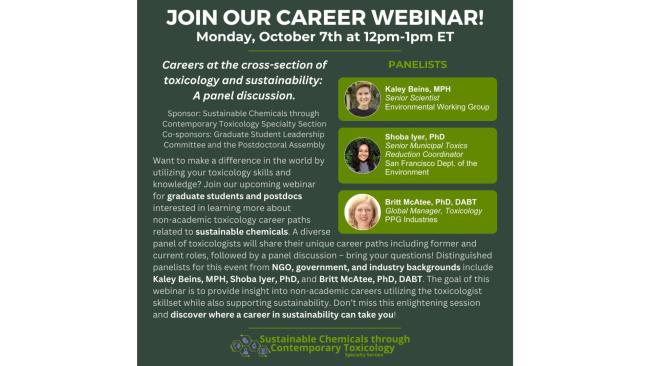
A green info graphic shows three smiling people, in order from top to bottom their names are: Kaley Beins MPH, Shoba Iyer PhD, and Britt McAtee PhD DABT. Large white text reads: Join our career webinar, Monday October 7th at 12pm-1pm ET. the event description follows, which can accessed in full further down the page.

Event Description

Hosted by: The SOT Sustainable Chemicals through Contemporary Toxicology Specialty Section, the Graduate Student Leadership Committee, and the Postdoctoral Assembly


Want to make a difference in the world by utilizing your toxicology skills and knowledge? Join our upcoming webinar for graduate students and postdocs interested in learning more about nonacademic toxicology career paths related to sustainable chemicals. A diverse panel of toxicologists will share their unique career paths including former and current roles, followed by a panel discussion—bring your questions! Distinguished panelists for this event from industry, nongovernmental organizations, and government backgrounds will provide insight into nonacademic careers utilizing the toxicologist skillset while also supporting sustainability. Don’t miss this enlightening session and discover where a career in sustainability can take you! 


Speakers: 

• Kaley Beins, MPH, Senior Scientist, Environmental Working Group 

• Shoba Iyer, PhD, Toxicologist, San Francisco Department of the Environment 

• Britt McAtee, PhD, DABT, Global Manager, Toxicology, PPG Industries

Event Address

United States

Additional Host Organizations
Sustainable Chemicals through Contemporary Toxicology
Intended Audience
Keyword Tags

Live Conversation with John Warner: Learning from Nature's Chemistry Live Conversation

Event

Live Conversation with John Warner: Learning from Nature's Chemistry Live Conversation
Event Date
-
Event Type
Event Format
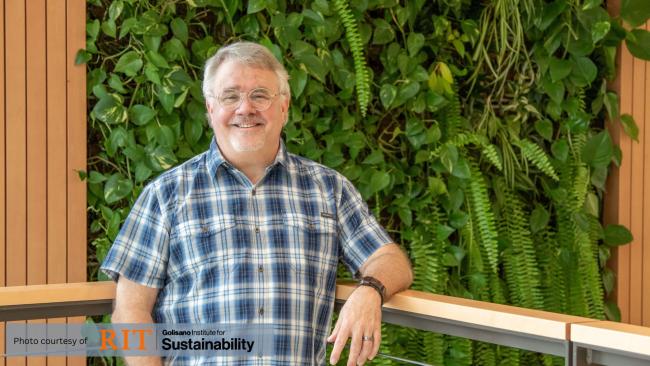
A white man in a blue plaid shirt smiles, standing in front of a wall covered in vibrant green ferns. Small white text reads: ask nature, hive-- the text is punctuated by a small hexagonal pattern.

Event Description

The AskNature Hive Live Monthly Conversation Series continues with John Warner, a world-renowned chemist, President and CEO of the Technology Greenhouse, and a leading advocate for the development of non-toxic, sustainable materials. In this month's conversation, John will share his insights and new reflections on how biomimicry principles can revolutionize chemical design and create sustainable solutions. With numerous patents and publications to his name, John has dedicated his career to pioneering green chemistry practices that mimic nature’s processes, reducing their environmental impact and promoting human health.


Event Address

United States

Additional Host Organizations
Biomimicry Institute
Intended Audience

Observe, Wonder, Think

Event

Observe, Wonder, Think
Event Date
-
-
-
-
-
-
-
Event Type
Event Format
Against a magenta background, two young scientists are drawn in a cartoon style, conducting experiments and surrounded by molecules and beakers. White and yellow text reads: Observe, Wonder, Think

Event Description

New Observe Wonder Think format for 2024-25. This year we are focusing on K-12 teacher peer collaboration. You are our best resource. There will be space for teachers to bring the resources, labs, lessons, articles that they are seeking to implement. What are the things you are learning as you implement? What challenges are you facing as you implement green chemistry in your classroom and lab? What has really worked well for you? Are there elements of your lessons/labs that you really need help with before implementation? Come and talk with your K-12 peers in the Green Chemistry Community of Practice. We are here to support, accompany, encourage and learn together. We will have speakers periodically to share what has worked in their classrooms, or to share lab safety tips. Register to attend. Only speaker sessions will be recorded, included with registration.


Esther Hines, retired chemistry teacher, ACS mentor and coach, adjunct chemistry faculty, will facilitate Observe Wonder Think monthly, third Thursdays, at alternating evening times.


For the event on January 16th, 2025, chat with us before, during, and after OWT in our Environmental Justice forum! Hint: this forum is part of the January Scavenger Hunt Week activity!

Event Address

United States

Use This Not That: Safer Substitutions for Methylene Chloride

Event

Use This Not That: Safer Substitutions for Methylene Chloride
Event Date
-
Event Type
Event Format
The image shows two blue, metal canisters, one is labelled "DCM" and one is labelled "?" there is a green arrow between them pointing to the "?" the white text reads: got DCM?

Event Description

Image
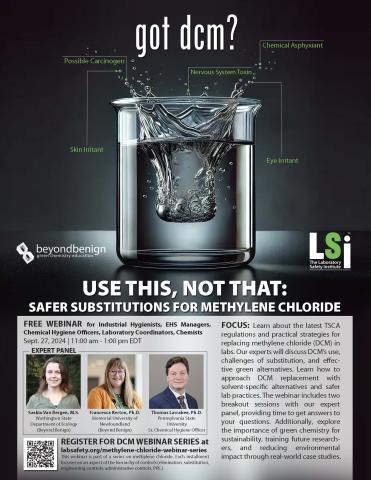
A beaker full of clear liquid is shown splashing.

From the Lab Safety Institute:

Join our webinar on September 27th at 11:00 AM EST to explore the latest TSCA regulations on methylene chloride and their impact on lab practices. Learn practical strategies for substituting methylene chloride in research and school labs and discover effective methods for finding safer, green chemistry alternatives with our expert partners, Beyond Benign.


More about the Lab Safety Initiative's Methylene Chloride Webinar Series:

This webinar series will focus on actionable steps to comply with the EPA TSCA final rule on methylene chloride. Walking through the hierarchy of controls, each installment will focus on a hazard control method (elimination, substitution, engineering controls, administrative, PPE) applicable to laboratory handling of this common reagent.

The webinar series will help participants:

  • Meet the EPA TSCA regulatory requirements
  • Provide guidance on selecting safer alternatives to methylene chloride
  • Update processes to promote safety and minimize exposure by developing exposure control plans (ECPs)
  • Offer practical strategies for managing exposure, implementing safety controls, and maintaining compliance documentation

Designed for anyone in academia or industry who uses methylene chloride, this webinar series offers essential strategies to navigate new regulatory landscapes and enhance laboratory safety culture.


Event Address

United States

Additional Host Organizations
Lab Safety Institute
Intended Audience

Making strides in sustainable laboratories: Examples of recent initiatives

Event

Making strides in sustainable laboratories: Examples of recent initiatives
Event Date
-
Event Type
Event Format
Chemistry World and RSC webinar image showing generic lab glassware and the title of the event

Event Description

Lab sustainability is increasingly at the forefront of decision making in science centres around the world, as evidenced by the Royal Society of Chemistry (RSC) Sustainable Labs report and the high level of interest in the RSC Sustainable Lab grants. 


In this hour-long, interactive webinar you will hear from recipients of the first round of the RSC Sustainable Labs grant whose projects seek to answer questions in topics areas including solvent choices and reuse of single use plastics. You will hear about the problems they’re trying to solve and how findings from their initial results can be actioned. By joining this webinar, you will learn how chemical scientists are looking to solve challenges faced when making more sustainable choices in the lab. You will also hear perspectives on the broader challenges in sustainable labs and efforts by the wider research community – including major funders – to drive more sustainable laboratory practices. 


The webinar will provide useful and actionable information as well as highlighting the opportunity to apply for the second round of RSC Sustainable Laboratories grants. 


The RSC will send a certificate of attendance to everyone who joins us live for the event. Please make sure you register using exactly the name you want on the certificate.


Note: this webinar will run from 3 - 4 pm British Standard Time (10 - 11 am Eastern Time).
 

Event Address

United States