Welcome to the GCTLC Library. Use the search and filter options below to find green chemistry education resources and curriculum materials from community members from across the world. You can also submit a new resource to the library. For information for authors and reviewers, please consult the Guidelines for Submission and Review of Learning Objects.

Stoichiometry: Combustion, Fuels, and Green Chemistry Metrics
This module connects ideas across topics in a first semester introductory chemistry course to explore the impacts of combustion reactions. By motivating students to understand the relationship between reaction completion and yield, and molar enthalpies and reaction efficiency in the context of selecting fuels for a fire, educators can explore both safety and sustainability without additional ...
Stoichiometry: Reaction of Iron with Copper(II) Sulfate
Students use stoichiometry to deduce the appropriate equation for the reaction between solid metallic iron and a solution of copper(II) sulfate. This reaction produces solid metallic copper, which is precipitated as a finely divided red powder in a single displacement reaction. During the reaction, atoms from a solid metal exchange with different metal ions in a salt solution. The iron produced ...
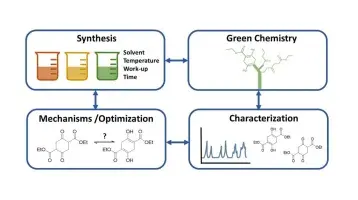
Structure Determination in the Green Undergraduate Laboratory
This learning object focuses on the green and sustainable condensation reaction of diethyl succinate and can be scaffolded depending on needs and equipment. The unexpected product of this reaction works well for a challenging structure determination lab and the nature of the starting materials points to responsible sourcing and alignment with UNSDGs.
Co-author Hannah Snider contributed ...
Student participation in a coastal water quality citizen science project and its contribution to the conceptual and procedural learning of chemistry
The study by J. L. Araújo examines how a year-long citizen science initiative—PVC: Perceiving the Value of Chemistry—engaged 442 Portuguese middle school students and 9 chemistry teachers in monitoring coastal water quality and detecting microplastics. Through hands-on analysis of physicochemical parameters (such as pH, turbidity, salinity, nitrate/nitrite levels, and dissolved oxygen) and ...
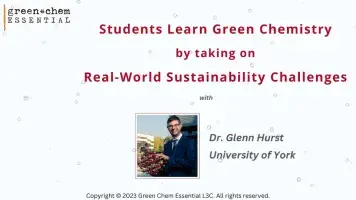
Students Learn Green Chemistry by Taking On Real-World Sustainability Challenges
In this episode, Professor Glenn Hurst takes his students at the University of York out into the world so they can see firsthand how their training in chemistry and chemical engineering can be channeled to help tackle sustainability challenges.
Along the way, the students learn the value of community engagement and evaluate their green chemistry and green engineering solutions in the context of ...
Styrene-Free Soybean Oil Thermoset Composites Reinforced by Hybrid Fibers from Recycled and Natural Resources
This study introduces a sustainable, styrene-free thermoset composite derived from acrylated epoxidized soybean oil (AESO) and reinforced with hybrid fibers sourced from recycled PET, bamboo, polyester, and ethylene-propylene (ES) fibers. To replace toxic and volatile styrene, the researchers synthesized glyceryl trimethacrylate (GTMA) from biodiesel-derived glycerol as a bio-based reactive ...
Substitution of carcinogenic solvent dichloromethane for the extraction of volatile compounds in a fat-free model food system
This published article looks at alternative solvent options to dichloromethane (DCM) for extraction of volatile compounds. By exploring the physico-chemical properties and hazard characteristics of the solvents and analyzing their efficiency in extracting volatile compounds from a fat-free model food product, safer options to DCM were identified.
Full citation: Cayot, N.; Lafarge, C.; Bou-Maroun ...
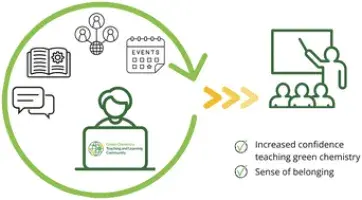
Surveying user experiences in an inclusive online green chemistry education community of practice
The Green Chemistry Teaching and Learning Community (GCTLC)—launched in October 2023—is an online platform dedicated to fostering a global community of practice (CoP) that supports the integration and advancement of green and sustainable chemistry in chemical education systems worldwide. Consistent with the platform's mission and vision, the success of such a CoP requires an understanding of how ...
Sustainable Chemistry Definition
The Expert Committee on Sustainable Chemistry (ECOSChem)—representing a broad set of constituencies has developed a clear and actionable definition for "sustainable chemistry" along with a set of criteria that may be adopted and adapted to different constituencies and decision contexts, including in policy, education, corporate, and investment decision making.
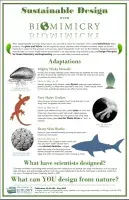
Sustainable Design with Biomimicry Poster
This poster explains what biomimicry is and introduces the idea of sustainable design. It provides examples of biomimicry and mentions an innovation developed in the Pacific Northwest that won a green chemistry award. A supplemental document also mentions some lessons and resources that could be taught in the classroom. It was developed by the Washington State Department of Ecology.
Sustainable Invention: An Exploration of Bioplastics - Module 1
*This is Module 1 of a 4 Module, multi-lesson unit. Sustainable Invention: An Exploration of Bioplastics is a unit that has been developed to introduce middle school students and educators to sustainable invention and green chemistry principles. The Sustainable Invention unit seeks to address the challenges of integrating invention education into middle school science curricula and advance STEM ...
Sustainable Invention: An Exploration of Bioplastics - Module 2
* This is Module 2 of a 4-Module, multi-lesson unit. Sustainable Invention: An Exploration of Bioplastics is a unit that has been developed to introduce middle school students and educators to sustainable invention and green chemistry principles. The Sustainable Invention unit seeks to address the challenges of integrating invention education into middle school science curricula and advance STEM ...
Sustainable Invention: An Exploration of Bioplastics - Module 3
*This is Module 3 of a 4 Module, multi-lesson unit. Sustainable Invention: An Exploration of Bioplastics is a unit that has been developed to introduce middle school students and educators to sustainable invention and green chemistry principles. The Sustainable Invention unit seeks to address the challenges of integrating invention education into middle school science curricula and advance STEM ...
Sustainable Invention: An Exploration of Bioplastics - Module 4
*This is Module 4 of a 4-Module, multi-lesson unit. Sustainable Invention: An Exploration of Bioplastics is a unit that has been developed to introduce middle school students and educators to sustainable invention and green chemistry principles. The Sustainable Invention unit seeks to address the challenges of integrating invention education into middle school science curricula and advance STEM ...
Sustainable Preparation of an Earth-abundant Metal Acetylacetonate Complex
This experiment highlights the synthesis of the Earth-abundant metal complex, Fe(acac)3 (acac = acetylacetonate), using an approach that is greener than traditional published syntheses. Students will also have an opportunity to determine the magnetic susceptibility of this complex and to learn about NMR spectroscopy.
Sustainable STEM Lesson 1: Beginning an Investigation by Gathering Evidence
This lesson introduces the global problem of plastics and sets the stage for designing a biodegradable cell phone case made from renewable materials. Students will consider their own impact on the environment through their personal choices while exploring the scale of effect that one product can have.
This project came about from a collaboration between Beyond Benign and Steelcase.
Sustainable STEM Lesson 2: Using Engineering Design to Make a Prototype
In this lesson, students will be tasked with designing a biodegradable cell phone case made with mycelium material by Ecovative Design. They will explore how Ecovative is combating the global problem of plastics by using Styrofoam-alternative materials grown from mycelium, which are the parts of a fungi analogous to the roots of a plant. They will then be introduced to the engineering design ...
Sustainable STEM Lesson 3: Life Cycle
In this lesson, students will take part in a very important task typical of any scientist or engineer: reviewing and revising their experimental procedure. Together, their changes will highlight the three criteria important for green chemistry technology, which allows for discussion of the sustainability of their mycelium cell phone case.
This project came about from a collaboration between ...
Sustainable STEM Lesson 4: Making Mushroom Material
In this lesson, the students reflect on where their project is in the engineering design process and build their final product: a mycelium material cell phone case. They then create data tables that they will fill in throughout the growth process to help guide their product evaluation. This part of the unit takes approximately 10-15 days, depending on the growth of the mycelium which depends on ...
Sustainable STEM Lesson 5: Testing the Cell Phone Cases
In this lesson, students will revise those procedures and use them to evaluate their mycelium cell phone cases. They will then use the information from their experiments to draw conclusions about their final product and choose one case to recommend.
This project came about from a collaboration between Beyond Benign and Steelcase.
Sustainable STEM Lesson 6: Presenting a Sustainable Solution
This lesson challenges students to consider the information they have gathered about the cost, safety and performance of their case and communicate the details of their final product in a presentation.
This project came about from a collaboration between Beyond Benign and Steelcase.
Sustainable STEM Overview
The Sustainable STEM curriculum features a 6-lesson unit focusing on sustainable design. Students create their own cell phone case out of renewable mushroom material and see how the product aligns with the three criteria of green chemistry.
The mushroom material was developed by Ecovative as a Styrofoam replacement for packaging.
Sustainable STEM also features 3 stand-alone lessons.
- Fabulous ...
Sustainable STEM: Fabulous Fabrics
Students will consider the difference between natural and synthetic fibers and investigate the ways that a variety of fabrics will interact with both basic and acidic dyes.
This project came about from a collaboration between Beyond Benign and Steelcase.
Sustainable STEM: Polymer Properties
In this lesson, students will explore the basics of polymer science, using pipe cleaners and colored penne to create models. Then, students will create two different slimes using chemical reactions and consider the difference between naturally derived and synthetic materials.
This project came about from a collaboration between Beyond Benign and Steelcase.
Sustainable STEM: Surefire Sharklet Lab
In this lesson, students will be introduced to biomimicry and Sharklet film. They will then investigate how Sharklet works through a hands-on experiment that simulates the accumulation of bacteria on surfaces with and without the pattern.
This project came about from a collaboration between Beyond Benign and Steelcase.
Synthesis and Analysis of Biodiesel Unit
Fossil fuels (natural gas, coal, oil) are non-sustainable and non-renewable resources that our current society has become heavily dependent on. Petroleum (literally rock oil) is the source of gasoline and diesel gas, two common fuels that keep our automobiles running. Prices of these petroleum based fuel are rising due to their high demand and scarcity. In addition, the burning of these fuels ...
Synthesis and Free Radical Copolymerization of a Vinyl Monomer from Soybean Oil
This Learning Object is based on the research article “Synthesis and Free Radical Copolymerization of a Vinyl Monomer from Soybean Oil”, which explores the chemical transformation of renewable feedstocks into polymerizable materials. In this work, soybean oil is chemically modified to produce a vinyl-functionalized monomer that can undergo free radical copolymerization. The study demonstrates how ...
Synthesis of Naphthyl Butyl Ether
This is a laboratory experiment for Organic Chemistry for a greener SN2 reaction. The reaction uses a greener solvent and produces a benign product. It was published in J. Chem. Ed.
A Simple SN2 Reaction for the Undergraduate Organic Laboratory
John J. Esteb, John R. Magers, LuAnne McNulty, Paul Morgan, and Anne M. Wilson
Journal of Chemical Education 2009 86 (7), 850
DOI: 10.1021/ed086p850
Synthesis of substituted N-phenylmaleimides and use in a Diels–Alder reaction: a green multi-step synthesis for an undergraduate organic chemistry laboratory
This paper presents a minimally hazardous, environmentally friendly, and energy-efficient reaction sequence for a sophomore-level Organic Chemistry lab, aimed at synthesizing N-phenylmaleimide precursors for a Diels–Alder reaction. The synthesis, which involves two steps from maleic anhydride and a substituted aniline, produces a valuable class of compounds with biological significance. The ...
Systems thinking approaches for international green chemistry education
This overview outlines the recent progress made in addressing the United Nations Sustainable Development Goals through educators incorporating systems thinking approaches within green and sustainable chemistry education. A blend of programme-level and course-level approaches to embedding systems thinking into teaching is discussed together with more specific resources such as practical experiments ...
Tackle poverty in chemistry lessons
This article summarizes ideas of activities to help you energize your students to tackle poverty using their chemistry learning.
The significant role that chemistry plays in the battle to end global poverty is related to the potential to mediate the harmful effects of poverty. This resource highlights three key reasons we need to get comfortable talking about poverty in chemistry classrooms:
1 ...
Teaching Green Chemistry with Epoxidized Soybean Oil
The integration of green chemistry principles in academics reflects growing student interest in renewable resources and environmental sustainability, driven by increasing awareness of global climate change. Educators must continually expand their green chemistry pedagogy to align with current industry and research trends. In this article, the synthesis of epoxidized soybean oil (ESO) was explored ...
Teaching green chemistry, sustainability ethics, and toxicity using nail polish removers
Ingredients in nail polish and polish removers are the primary causes of occupational health problems manicurists frequently face. Several key concepts of green chemistry can be taught to an undergraduate audience using nail polish removers as a case study. Students generated green profiles of various nail polish removers available on the market based on the 12 principles of green chemistry. This ...
Testing Greener Solvents for Extraction of PCBs in Water Samples
In this upper-level undergraduate chemistry laboratory experiment, students will experience the challenge of finding a greener yet effective extraction solvent. Students will test a replacement solvent in a modified EPA method that traditionally uses dichloromethane (methylene chloride) to extract PCBs from water samples. Students will gain experience with common laboratory techniques and tools ...
Testing Sunscreen Effectiveness and Water Solubility
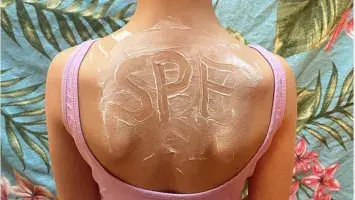
What should you NOT forget when going outside on a sunny day? To put sunscreen on! Sunscreen is important because it protects your skin from sunburn. But there are so many sunscreens to choose from: different methods of application (sprays and lotions), different Sun Protection Factors (SPFs), and different ingredients. Which one is best? In this science project, you will test the effectiveness of ...
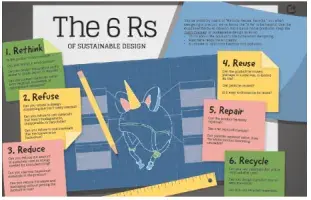
The 6 "R"s of Sustainable Design
This poster invites your class to learn how to design more sustainable products by thinking about a product's full life cycle using the 6 Rs of Sustainable Design. It was developed by the Washington State Department of Ecology.
Copies of this poster are also available in Spanish, Marshallese, Farsi, Ukranian, and Russian.
You can order the poster for free by going to "request a copy" or download ...
The Adoption of Green Chemistry in Brazilian Higher Education
Despite being responsible for many essential products in our daily lives, the chemical industries have not given proper attention to environmental issues for a long time. In the late 90’s, Green Chemistry (GC) emerged as a field of chemistry responsible for dealing with the relationship between the products used and their effects on human health and the environment. However, the employability of ...
The Chemetry eShuttleTM Process: Manufacturing ethylene dichloride with less energy and without a toxic intermediate
This case study based on the Chemetry eShuttle process that won a Presidential Green Chemistry Challenge Award (Small Business) in 2018. This process results in the production of ethylene dichloride (EDC) with reduced energy use and less toxicity by eliminating production of elemental chlorine. This is a nice application of electrochemistry, which is covered at the end of the second semester of ...
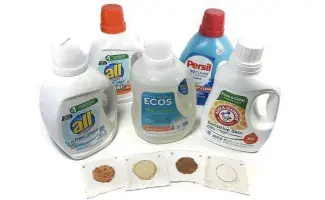
The Cold Wash Challenge: Testing How Well Enzymes Work in Laundry Detergents
What do you think are some of the most common stains on clothes? If you thought of grass, grease, ketchup, blood, or toothpaste stains, you are correct. Everyday activities like eating, playing outside, or doing sports can result in a lot of dirty laundry. Luckily, we have laundry detergents that can get our clothes clean again! Some of these detergents contain enzymes that are intended to boost ...
The Discovery-Oriented Approach to Organic Chemistry. 7. Rearrangement of trans-Stilbene Oxide with Bismuth Trifluoromethanesulfonate and Other Metal Triflates. A Microscale Green Organic Chemistry Laboratory Experiment
It is well known that epoxides can undergo rearrangement to yield carbonyl compounds in the presence of a Lewis acid catalyst. Classically these catalysts have included a wide variety of compounds some of which are hazardous and harmful. The impetus for this experiment came from a previous lab taught by the authors in which toxic, corrosive boron trifluoride etherate was used to catalyze the ...
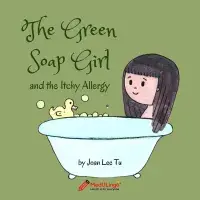
The Green Soap Girl and the Itchy Allergy
Alice tries to use medication and home remedies, but nothing works on her itchy skin. Then she learns a very long word called "methylisothiazolinone". This resource is a 32-page picture book for 4-8 year-olds.
The Green Soap Girl and the Itchy Allergy is the story of a lovable girl named Alice who struggles with eczema until she discovers that she has methylisothiazolinone allergy. Loosely based ...
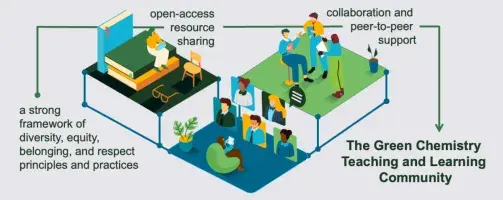
The journey towards an inclusive green chemistry education community of practice by prioritizing diversity, equity, belonging, and respect for an open-access online platform
This article describes how the GCTLC Team and Leadership Committee used a framework of diversity, equity, belonging, and respect (DEBR) to design the GCTLC to be an inclusive community of practice for green chemistry educators. We show how we intentionally interweave DEBR across all parts of the site and our internal programming to better enable a strong sense of belonging for users who join the ...
The Massive Problem of Microplastics
This article explores the significant environmental impact of microplastics, tiny plastic particles less than 5mm in size. These particles originate from larger plastic debris breaking down and microbeads from cosmetic products. Microplastics are pervasive in marine environments, posing threats to wildlife through ingestion and chemical contamination. The article highlights the urgent need for ...
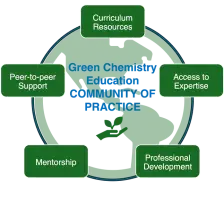
The Need for and Evolution of a Global Community of Practice in Green Chemistry Education
This article published in the Journal of Chemical Education provides a brief overview of the history of the development of the green chemistry education community over the past few decades. It then provides a summary of survey data collected from ACS members in 2020, include understand what green chemistry concepts are important for educators, how prepared they feel to teach them, what barriers ...
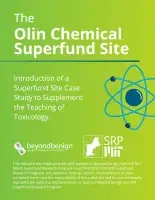
The Olin Chemical Superfund Site Case Study
The Olin Chemical Superfund Site case study module consists of four lesson units and a classroom follow-up activity, designed to introduce students to the U.S. EPA’s Superfund Program and the history of the chemical industry. It also delves into the toxicology of chemicals released into the environment, while helping students explore green chemistry innovations that aim to eliminate the use of ...
The pH scale and the chemistry of ocean acidification
This resource delves into the concept of pH changes using ocean acidification as a context. It presents questions that help students establish the connection between pH changes and their impact on marine organisms in the context of ocean acidification.
The Reaction of Carbon Dioxide with Water
The experiment uses exhaled breath to explore the reaction between carbon dioxide and water. Students blow into a flask containing water and an indicator, causing a color change as carbon dioxide dissolves and forms carbonic acid, a weak acid. The experiment illustrates concepts of gas-liquid reactions, pH indicators, and the impact of carbon dioxide on water chemistry.
The relevance of sustainable laboratory practices
Researchers across the planet play a key role in enhancing the energy-, feedstock- and material-transition necessary to allow for circularity and thus mitigation of the climate crisis. Their contribution, education and skills are necessary to develop a sustainable future by meeting the UN's Sustainable Development Goals (SDGs). Scientific research is also vital for climate awareness and solutions ...